
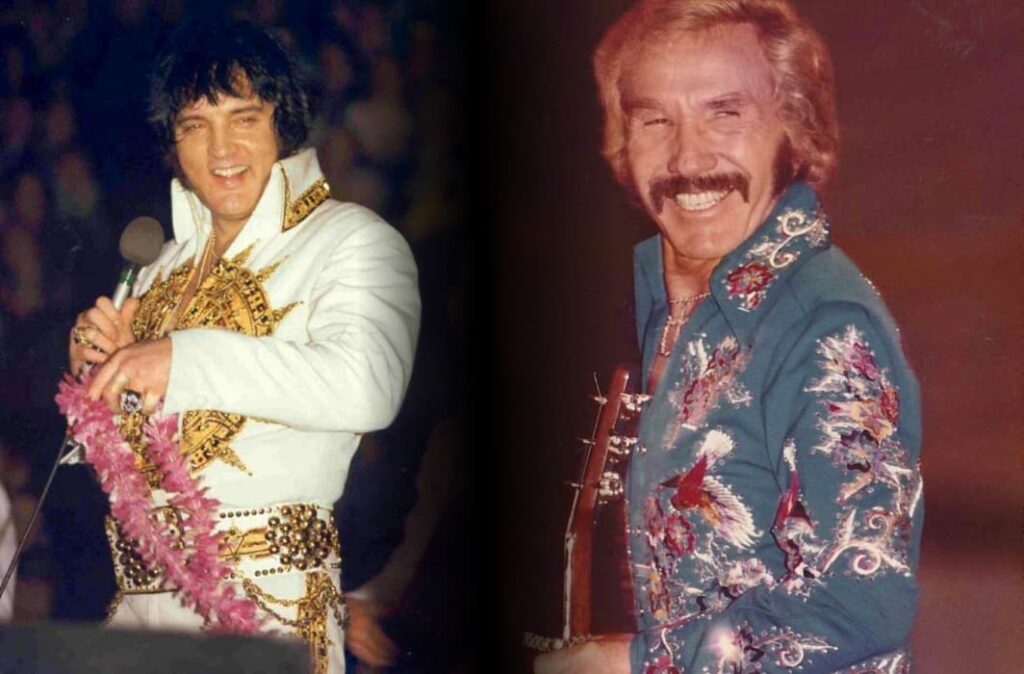
A quiet surrender to destiny, where love is accepted not as choice but as an inescapable truth.
When Marty Robbins recorded Can’t Help Falling in Love, it did not arrive as a chart dominating single nor announce itself with commercial urgency. Unlike many of his biggest releases, the song circulated primarily as an album performance within his broader studio output, absorbed into the long playing world rather than the singles charts. It belongs to the period when Robbins was deepening his role as an interpreter of emotionally resonant material, allowing his voice to inhabit songs already heavy with cultural memory rather than reshape them for radio conquest.
What makes Can’t Help Falling in Love so compelling in Robbins’ hands is not novelty, but restraint. By the time he recorded it, the song already carried a near mythic status in popular music, built on its stately melody adapted from a centuries old European love theme and lyrics that frame love as fate rather than desire. Robbins approaches the song with reverence, stripping away theatrical excess and replacing it with something closer to confession. His baritone, famous for its clarity and warmth, moves through the verses with measured calm, as though each line is being discovered rather than performed.
The song itself is deceptively simple. Its language avoids poetic ornament, relying instead on plain declarations and moral imagery. Words like wisdom, sin, and falling give the lyric a gravity that feels almost biblical. In Robbins’ reading, these ideas take on a particularly mature weight. This is not youthful infatuation tumbling forward without consequence. It is an older voice acknowledging that love arrives with its own authority, indifferent to caution or logic. When he sings of inevitability, it feels earned, as though spoken by someone who has already tested resistance and found it useless.
Musically, Robbins leans into the song’s hymn like structure. His phrasing is unhurried, allowing the melody to breathe fully. There is no rush toward the refrain, no attempt to heighten drama through vocal acrobatics. Instead, he trusts stillness. This aligns with the broader arc of his career, where even at his most dramatic, Robbins favored narrative clarity over excess. Here, that instinct turns a familiar song into something quietly introspective.
Culturally, Can’t Help Falling in Love has endured because it speaks to a universal human surrender. Robbins’ version contributes to that legacy by reminding listeners that love does not always arrive as excitement. Sometimes it comes as recognition. His interpretation feels less like a vow made in the heat of passion and more like a truth spoken after long reflection. It is the sound of someone standing still while emotion moves through him.
In the end, Marty Robbins does not try to claim the song as his own. He honors it by stepping back, allowing its timeless message to remain intact. That humility is precisely what gives his version its quiet power. It lingers not because it demands attention, but because it understands that some feelings do not need to be announced. They simply are.