
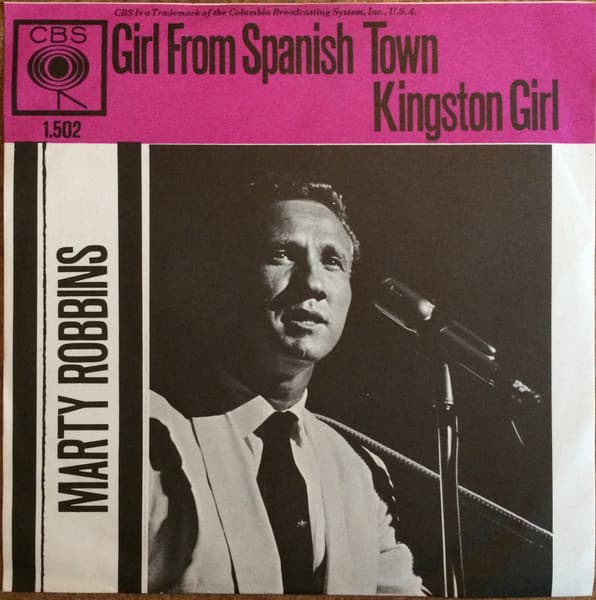
Portrait of longing where romance drifts like sea air and memory does the singing.
Released as an album track rather than a charting single, Girl From Spanish Town appears on The Drifter, a mid 1960s record that captures Marty Robbins at a moment of stylistic curiosity and emotional range. While the song itself did not register independently on the singles charts, its presence within an album that performed strongly in Robbins’ catalog situates it firmly inside his commercially confident and creatively exploratory period. Framed by The Drifter, a record known for its restless spirit and global influences, the song finds its meaning not in chart arithmetic but in atmosphere, tone, and narrative suggestion.
What makes Girl From Spanish Town endure is not a documented backstory or a dramatic anecdote from the studio floor, but the way Robbins constructs a world with remarkable restraint. The song leans into the tradition he mastered so well, the traveler’s tale, delivered with a voice that sounds as if it has already lived through the memory it is recounting. Spanish Town is not merely a location. It becomes a symbol of distance, of an encounter suspended in time, of a romance defined as much by its transience as by its intensity.
Lyrically, Robbins avoids melodrama. There is no overt heartbreak, no raised voice pleading for return. Instead, the song breathes with acceptance. The girl is remembered, not reclaimed. This emotional posture is crucial. Robbins often sang of love lost to circumstance rather than betrayal, and here he frames separation as an inevitable consequence of movement, geography, and fate. The narrator does not chase the past. He honors it, then lets it remain where it belongs.
Musically, Girl From Spanish Town reflects Robbins’ fascination with rhythm and texture beyond traditional Nashville formulas. The arrangement carries a subtle lilt that suggests Caribbean or Latin influence without ever tipping into novelty. This restraint is key. Robbins understood that suggestion could be more powerful than imitation. The gentle sway of the melody reinforces the song’s emotional drift, creating the sense of a memory that rocks back and forth but never quite settles.
Within Robbins’ broader body of work, the song occupies an important emotional lane. It aligns with his quieter narratives, where the drama exists internally rather than in plot twists. These are songs about men who observe, who remember, who accept the limits of what love can be. In that sense, Girl From Spanish Town feels less like a confession and more like a reflection shared with the listener as an equal.
Decades later, the song remains a reminder of Robbins’ unique gift. He could turn a simple encounter into something timeless, not by exaggerating its importance, but by trusting its emotional truth. Girl From Spanish Town does not demand attention. It waits patiently, like a photograph tucked into an old record sleeve, ready to speak when the needle finally drops.