
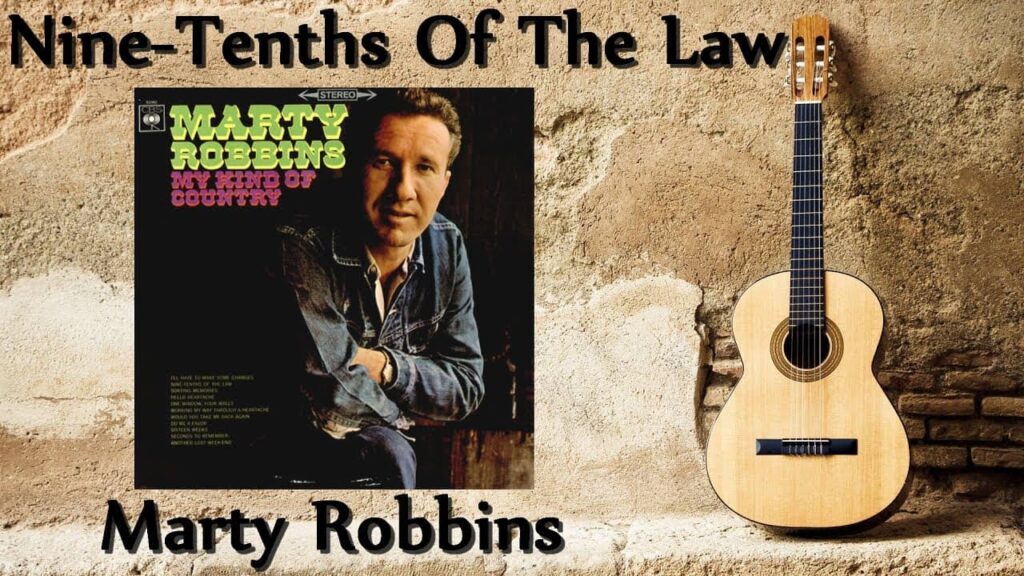
“Possession is Nine-Tenths of the Law,” Where Love and Claim Collide in Country Confession
In the quietly profound depths of Marty Robbins’ 1967 album My Kind of Country, the track **“**Possession Is Nine-Tenths of the Law” stands as a plaintive testament to the collision of desire and moral ambiguity in romantic allegiance. Though not issued as a major chart-topping single in his discography, the song has endured among fans of Robbins’ work on My Kind of Country, delivering one of his most unsettling yet simple narratives of love’s claim and possession.
Robbins was no stranger to storytelling that blended plainspoken emotion with the evocative textures of country music. By the mid-1960s he had already cemented his place in American music with hits like “El Paso” and dozens of successful singles on the Billboard country charts, and his body of work reflected a restless curiosity about narrative forms—from western ballads to heartbreak songs and contemplative character studies. “Possession Is Nine-Tenths of the Law” arrives in this mature phase of his career, a compact two-and-a-half-minute vignette about a speaker who professes love yet clings with a kind of stubborn claim that is as much about fear of loss as it is about affection.
Lyrically, the song appropriates the old adage that “possession is nine-tenths of the law”—a phrase rooted in common-law notions about ownership—as a metaphor for emotional possession. The narrator plainly states that his beloved loves another man, yet he “won’t let you go” and “won’t step out of the way,” because, in his view, his claim precedes all others. What gives this statement its unsettling power is his simultaneous acknowledgment of selfishness and his insistence that, for him, there is simply “no other way.” The repetition of the refrain hammers home this psychological loop: desire justified through possession, and a desperate refusal to yield even in the face of love’s freedom.
Musically, the arrangement reflects Robbins’ characteristic economy—simple yet evocative. Clean guitar lines and a steady rhythm section allow the vocal narrative to preside unadorned, placing the listener close to the speaker’s conflicted heart. There is no dramatic solo or bravado here; the song’s power lies in its stark honesty and the way Robbins inhabits a character whose claim is both ardent and uncomfortable. In contrast to Robbins’ more sweeping western epics, this track feels like a short story in song form—precise, intimate, and tinged with a moral ambiguity rarely explored so plainly in mainstream country of the time.
Within Robbins’ broader oeuvre, “Possession Is Nine-Tenths of the Law” occupies a quiet corner of reflection on human frailty. It is not a lament of heartbreak so much as a confession of an inner logic that binds love to control. As with many of Robbins’ best works, its emotional weight comes not from grand gestures but from its unwavering stare at an uncomfortable truth: that love, in human terms, is sometimes less about belonging and more about the fear of losing what one holds dear.
For the attentive listener, this song is both caution and confession, a snapshot of country music’s enduring ability to articulate complex emotional states in the simplest of phrases.