
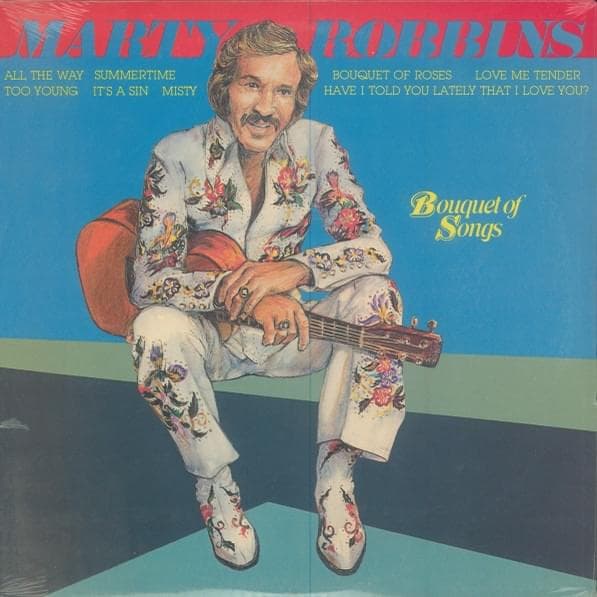
A LULLABY OF LONGING AND ETERNAL SUMMER
When Summertime unfolds in the voice of Marty Robbins, its opening lines become a gentle promise of ease, comfort, and hope for a better morning. On his 1962 album Marty After Midnight, Robbins offers this tender interpretation of the classic aria — itself originally composed by George Gershwin with lyrics by DuBose Heyward and Ira Gershwin — delivering a rendition that carries the weight of memory and the softness of a lullaby.
Jazz‑tinged solace from a country legend
Though there is no clear evidence that Marty Robbins’ version of “Summertime” was issued as a single or placed on the charts, the track stands as a striking testament to his versatility. Robbins, known for an expansive career spanning honky‑tonk country, Western ballads, pop crosses, and rockabilly, chose with “Summertime” to lean into the velvet intimacy of jazz‑pop standards.
Recorded on February 17, 1962, and included as track 7 on Marty After Midnight, Robbins’ “Summertime” arrives as part of a sequence of covers: in his own words, he took on songs from the Great American Songbook, transforming them not with brash novelty, but with reverent simplicity.
The emotional architecture beneath the melody
At its core, “Summertime” is a lullaby — born in the 1935 opera Porgy and Bess, its original incarnation a spiritual‑inflected promise of protection, of comfort in hard times, addressed to a child. In Robbins’ hands, the song does not aspire to theatrical grandeur. Instead, he invites the listener into a close, dimly lit room — a world of whispered reassurance, of soft strings, of slow breathing. His phrasing is unhurried; each lyric hangs in the air, carrying both fragility and warmth. Critics have noted that his reading matches “sheer pop elegance.”
Unlike his blazing cowboy ballads or chart‑topping country hits, this rendition exists in a different realm — one of reflection rather than spectacle, solace rather than drama. Where many versions of “Summertime” lean on jazz improvisation or soulful delivery, Robbins opts for restraint. The result is a calm, nocturnal intimacy, like a memory half-remembered yet vivid in its emotional clarity.
Legacy beyond chart positions
“Marty After Midnight,” the album that houses “Summertime,” exemplifies Robbins’ breadth as an artist. In a career that delivered 17 number‑one country singles and dozens of Top 40 hits, he still found space — and audience — for an album of classic pop standards.
Though this version of “Summertime” may not be the most celebrated across the vast expanse of its many covers, it remains a quietly potent statement: that Robbins understood the power of restraint, of emotional subtlety. In a catalog full of high plains ballads, gunfighter epics, and teenage heartbreak anthems, his “Summertime” is a gentle detour — a late‑night serenade, a soft promise that when the cotton grows high and the fish jump, living can indeed be easy.
In the end, Robbins does not merely sing “Summertime.” He invites us to linger in its warm dusk, to close our eyes and dream of skies wide and endless, of lullabies carried on the hum of cicadas, of a summer that never ends.