
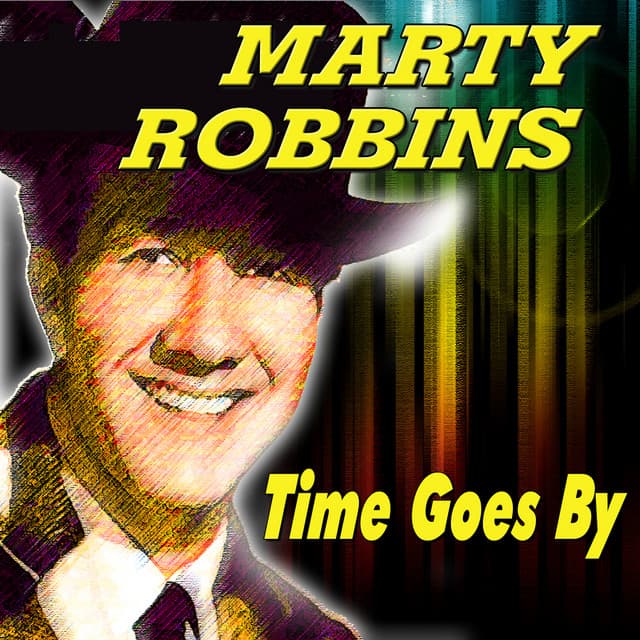
Time passes but some hearts remain unchanged
When Time Goes By first reached audiences, it charted at No. 14 on the US country chart in 1955 — a modest showing, yet enough to mark it as part of the early rise of Marty Robbins as a serious voice in American country music. Although this song did not ascend into his later pantheon of number-one smash hits, it stands as a telling early chapter in the long, melodic arc Robbins would trace over decades.
A Song Draped in Longing and Persistence
In its most elemental form, Time Goes By is a lament of unyielding love — a love that endures far beyond promises broken, far beyond distance or time. The lyrics speak with unwavering sincerity: “Time goes by and I still love you … Time goes by and still I haven’t changed.” There is no flourish of dramatics. No final showdown. Only the plain, quiet truth of a heart still waiting, still faithful, still aching for acknowledgement. In Robbins’ voice one senses the dust of long highways, the ache of solitude, the longing that time cannot dull.
Musically, the song reflects the spare and earnest country-ballad tradition of its era. There are no sweeping orchestras. There is no overt romantic idealization. Instead the arrangement supports the words — simple guitar, soft rhythm, space around the voice — allowing the emotional weight to settle gently, like dusk folding over an empty porch. In that space, Robbins becomes not just a singer but a companion to anyone who has ever looked back on a lost love, wondering whether time had changed everything — or nothing at all.
Early Career, Quiet Resolve
In 1955 Robbins was still shaping his identity as a singer. He had come from modest beginnings — a young man from Glendale, Arizona — and had begun to win modest attention on the country charts. Time Goes By is part of that formative period: not a marquee hit like El Paso would later become, but a thread in the tapestry that underpins Robbins’ lasting artistry.
The emotional honesty of the song hints at the mature balladry Robbins would later embrace with full authority. In his later classics — stories of outlaw love, heartbreak, longing, redemption — the seeds planted in Time Goes By would grow into sweeping narratives. Here is a quieter declaration of devotion, perhaps less glamorous, but no less real. It reveals a version of Robbins that is vulnerable, human, rooted in longing — a side that sometimes gets overshadowed by cowboy epics or his pop-country crossovers.
Legacy in Simplicity
Listening to Time Goes By today, after decades of polished production and genre evolution, is a return to simplicity. There is a purity here — of feeling, of voice, of intent — that is quietly timeless. Robbins does not demand attention with flashy solos or vocal theatrics. Instead, he offers something more intimate: a confession, a prayer, a memory.
In the grand sweep of Marty Robbins’ career, Time Goes By may not shine as the brightest star. But for those who listen closely, it remains a haunting echo from the early days — the sound of a heart refusing to surrender its hopes despite everything changing around it. Its emotional honesty foreshadows the profound storytelling that would define Robbins’ legacy.
For the listener attuned to nuance, Time Goes By stands as a testament that love need not declare itself with grandeur to be true. Sometimes all it needs is time.