
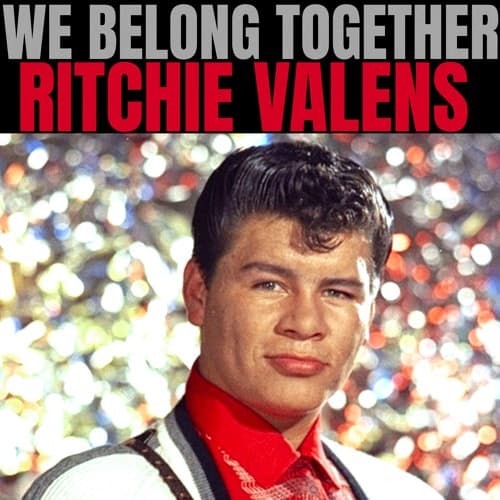
Teenage voice declares love not as fantasy, but as destiny carved into harmony.
When Ritchie Valens released We Belong Together in 1958, the song climbed into the Billboard Hot 100, peaking at number 32, a notable achievement for a seventeen year old artist still defining the boundaries of early rock and roll. It later found its canonical home on the self titled album Ritchie Valens, released in 1959, a record that would become both a promise and an epitaph. In the commercial shadow of later hits, We Belong Together nonetheless announced something vital. Valens was not merely a purveyor of youthful novelty. He was already articulating emotional certainty with a gravity far beyond his years.
At its core, We Belong Together is a declaration stripped of ornament. There is no dramatic plot, no clever lyrical twist. Instead, the song is built around repetition and insistence, a musical embodiment of devotion that does not argue its case but states it as fact. This was a hallmark of Valens’ brief but resonant career. His music often fused the raw directness of rhythm and blues with the melodic sweetness of pop balladry, and here that fusion feels almost confessional. The lyric “You’re mine, you’re mine” is not possessive so much as grounding. In the unstable emotional terrain of adolescence, the song offers love as something anchoring and inevitable.
Musically, the track leans heavily on doo wop traditions that were shaping late 1950s popular music. The backing vocals create a soft, cyclical cushion, reinforcing the song’s central idea of togetherness. Chord progressions resolve predictably, almost comfortingly, and Valens’ vocal performance sits at the intersection of vulnerability and assurance. He does not belt. He pleads, gently but persistently, as if aware that love must be reaffirmed to remain real. This restraint is key to the song’s enduring power. It invites the listener inward rather than overwhelming them.
What makes We Belong Together especially poignant in retrospect is how it reframes Valens himself. Often remembered primarily for cultural milestones and explosive energy, he is here revealed as a careful emotional stylist. The song captures a universal moment, that first certainty that love is not temporary or conditional but essential. For a generation coming of age alongside rock and roll, this kind of emotional clarity mattered. It gave form to feelings that were rarely articulated so plainly in earlier popular music.
Culturally, the song stands as a quieter counterpoint to the more exuberant chapters of Valens’ legacy. It reminds us that early rock and roll was not only about rebellion and rhythm, but also about tenderness and longing. In We Belong Together, love is not reckless. It is chosen, repeated, and sung into permanence. Listening now, decades later, the song feels less like a teenage vow and more like a timeless affirmation, preserved in vinyl, still asking the same question it always has. Who do we become when we dare to say, without irony or fear, that we belong.