
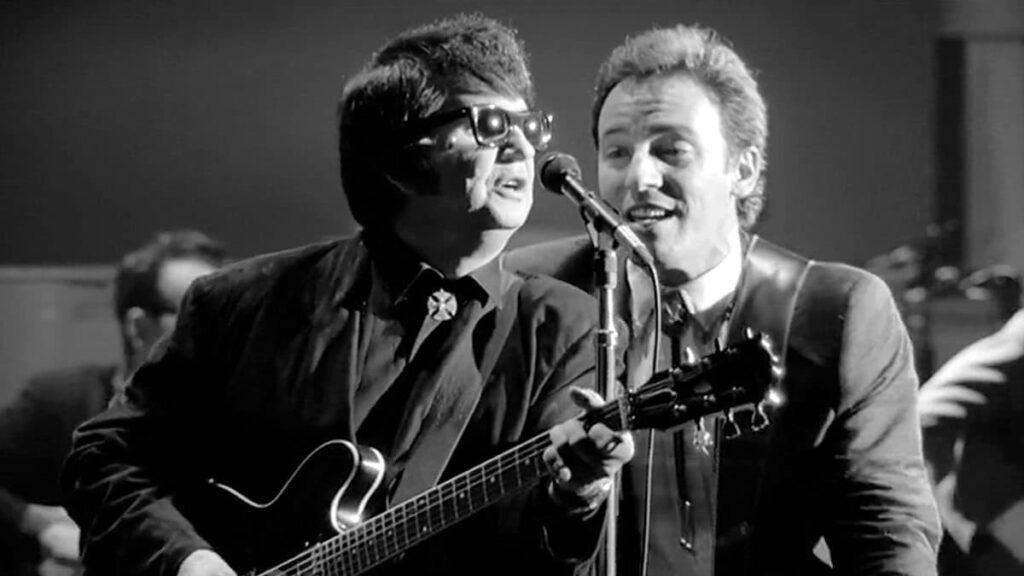
A final, luminous stand where friendship, memory, and song converge into something eternal
Released in 1989, Roy Orbison and Friends: A Black and White Night arrived not as a conventional album, but as a captured moment of reverence. Recorded during a 1987 television special and issued shortly after Roy Orbison’s death, the live album climbed to No. 12 on the Billboard 200 and reached No. 1 on the UK Albums Chart, confirming that its impact extended far beyond nostalgia. Backed by an informal supergroup of admirers and peers, Orbison stood at the center of a monochrome stage, delivering a career summation that felt less like a comeback and more like a benediction.
At its core, Roy Orbison and Friends: A Black and White Night is not about reinvention. It is about recognition. By the late 1980s, Orbison’s influence had long been absorbed into the bloodstream of popular music, yet his presence remained strangely elusive in the contemporary spotlight. This performance corrected that imbalance without spectacle or desperation. The stripped-down black-and-white presentation removed all distractions, leaving only the essential elements that had always defined Orbison’s art: the operatic voice, the disciplined melodies, and an emotional gravity that resisted fashion.
The “friends” surrounding him were not decorative guests. They were witnesses. Bruce Springsteen, Elvis Costello, Tom Waits, k.d. lang, Bonnie Raitt, and others did not attempt to modernize Orbison’s material. Instead, they leaned into it, harmonizing, stepping back, and allowing the songs to breathe. Their presence functioned as a quiet declaration of lineage. This was not merely a legend revisited, but a foundation acknowledged. Each shared glance and restrained harmony underscored the same truth: these songs had already outlived their era.
Musically, the performance revealed just how carefully constructed Orbison’s catalog was. Songs like Oh, Pretty Woman, Only the Lonely, and Crying unfolded with architectural precision. His voice rose not through force, but through control. Orbison’s genius lay in his refusal to resolve emotion easily. His melodies climbed toward release, only to hover there, suspended between longing and resignation. In this setting, those qualities felt amplified. The absence of visual color sharpened the emotional contrast, turning joy and sorrow into stark opposites rather than blended shades.
Culturally, Roy Orbison and Friends: A Black and White Night now stands as something rarer than a successful live album. It is a farewell that did not know it was one. Orbison performs with calm authority, unaware that this would become one of the final, definitive images of his career. That unintentional finality gives the album its enduring power. It is not haunted by decline or regret. Instead, it preserves an artist in full command of his gifts, surrounded by those who understood their debt to him.
In the end, this record does not ask to be remembered. It simply remains. A still photograph in sound, where time pauses long enough for greatness to speak for itself.