
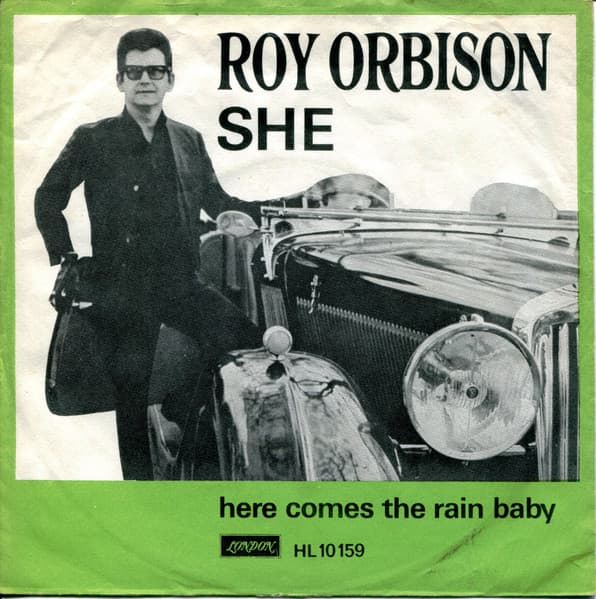
Standing calmly in the downpour, accepting heartbreak as something inevitable rather than tragic
Released in 1965, Here Comes The Rain, Baby arrived as a notable single by Roy Orbison, charting within the American Top 50 and gaining strong recognition in the United Kingdom, while also appearing on the album There Is Only One Roy Orbison. By this point in his career, Orbison was already established as a singular figure in popular music, an artist whose emotional gravity often outweighed commercial trends. This song did not announce itself as a grand reinvention. Instead, it quietly reaffirmed what made Orbison incomparable: his ability to render emotional resignation with dignity, restraint, and architectural precision.
At its core, Here Comes The Rain, Baby is not about surprise heartbreak. It is about anticipation. The rain of the title is not sudden, violent, or disruptive. It is expected, almost welcomed, as though the narrator has learned that sorrow is part of the climate of love. This framing is essential to understanding Orbison’s artistry in the mid 1960s. While many contemporaries dramatized loss through anger or pleading, Orbison approached it as a condition to be endured with composure. The song unfolds like a forecast already known to be accurate.
Musically, the arrangement reinforces this emotional posture. The rhythm is steady, unhurried, and unadorned by excess. There is no rush toward catharsis. The melody moves in measured arcs, allowing Orbison’s voice to carry the weight without theatrical flourishes. His singing here is notable for its control. Rather than climbing immediately into his famous operatic peaks, he holds back, letting the tension build gradually. When his voice finally opens, it does so not in desperation, but in acceptance.
Lyrically, the song speaks to emotional preparedness. The narrator recognizes the signs, understands the pattern, and braces for what comes next. This awareness removes bitterness from the equation. The rain becomes a metaphor not for punishment, but for inevitability. Love, in Orbison’s universe, is rarely stable. Yet there is grace in knowing this, in standing still as the weather changes rather than running from it.
Culturally, Here Comes The Rain, Baby sits at an interesting crossroads. Released during a decade increasingly defined by youthful rebellion and sonic experimentation, the song feels almost timeless in its emotional language. It belongs neither fully to early rock and roll nor to the emerging counterculture. Instead, it exists in Orbison’s private emotional territory, where vulnerability is expressed through elegance rather than confession.
Listening now, the song reads as a quiet lesson in emotional maturity. There is no attempt to rewrite the outcome, no plea for mercy, no illusion of control. Orbison presents heartbreak as something one learns to recognize, to endure, and to survive with one’s sense of self intact. In that calm acknowledgment lies the enduring power of the record. It is not the sound of a heart breaking loudly, but of one that already knows the sound of rain.