
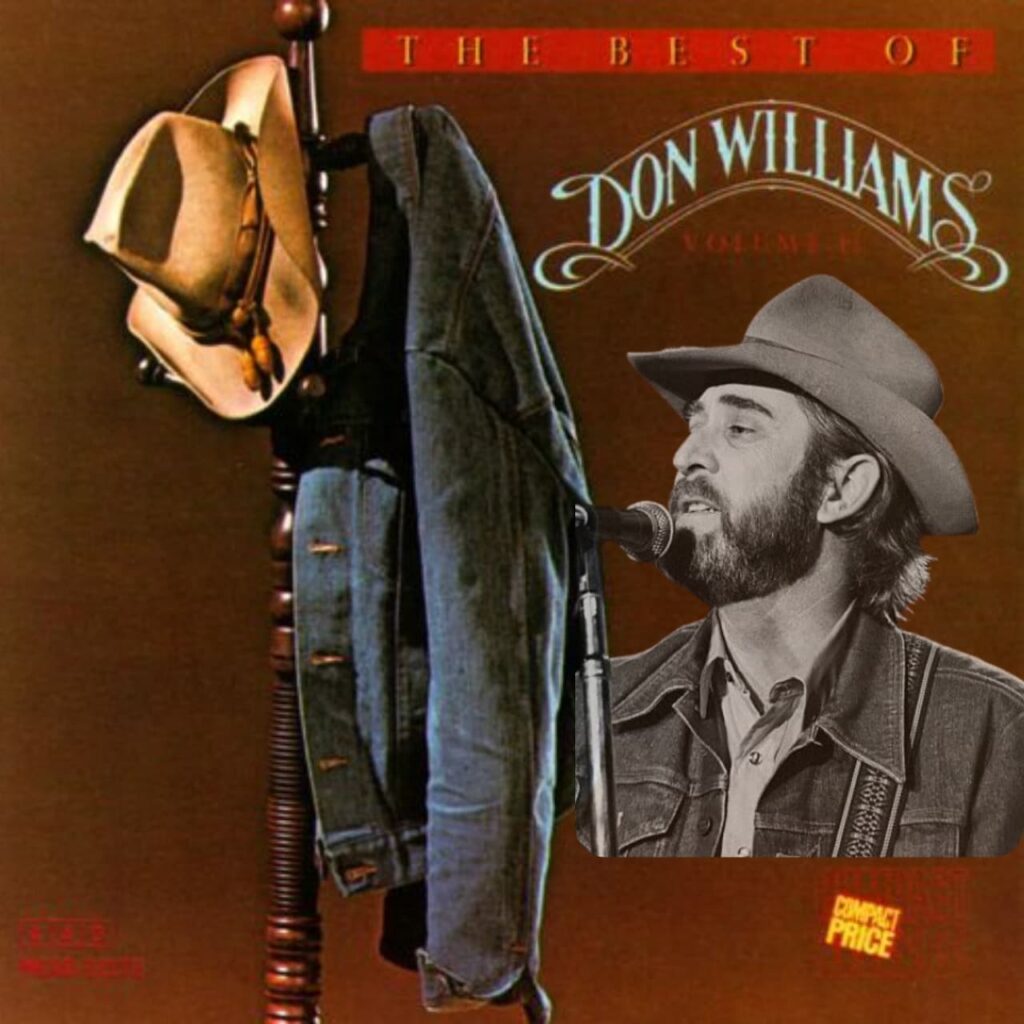
THE DAY COUNTRY MUSIC LOST ITS CALMEST VOICE. WHY DON WILLIAMS’ SILENCE HIT HARDER THAN ANY SCANDAL
In the annals of American country music, few moments felt as sobering as the withdrawal of Don Williams, a singer whose career was defined not by controversy or reinvention, but by restraint. When Williams stepped away from recording and touring in 2016, following decades of consistent chart presence, the absence itself became the message. At his commercial peak, songs like Tulsa Time reached No. 1 on the Billboard Hot Country Songs chart in 1978, drawn from the album Expressions, while a long string of Top 10 hits throughout the 1970s and 1980s established Williams as one of the genre’s most dependable voices. He was not attached to a single era or album. Rather, his catalog formed a continuous, reassuring line through country radio for more than three decades.
What made Williams singular was not innovation in sound, but refinement of spirit. Known widely as the Gentle Giant, he sang with a baritone that never forced emotion yet carried enormous emotional weight. His records moved slowly, deliberately, and with a sense of patience that felt almost defiant as country music grew louder and more theatrical. Where others leaned into heartbreak with grand gestures, Williams trusted understatement. A single line delivered plainly could feel heavier than any dramatic flourish.
The so called silence that followed his retirement resonated deeply because it was entirely in character. Williams had always avoided spectacle. He rarely chased trends, rarely explained his songs at length, and rarely placed himself above the material. When he left, there was no farewell tour framed as legacy building, no final album pitched as a closing statement. The quiet was complete, and therefore profound. In a genre increasingly shaped by public narratives and personal branding, his disappearance felt like the loss of an old moral compass.
Listening back to his recordings, the themes reveal why that absence carried such weight. Williams sang about devotion without sentimentality, loneliness without self pity, and faith without performance. His protagonists were adults who accepted life’s limitations and still chose tenderness. The arrangements supported this philosophy. Acoustic guitars breathed, rhythm sections held back, and melodies unfolded at human speed. These were not songs built for immediacy. They were built for endurance.
Culturally, Williams represented a strand of country music rooted in trust between singer and listener. He never asked the audience to be impressed. He asked them to listen. That contract held for decades, which explains why his silence felt louder than any scandal or headline. When a voice that has long offered steadiness disappears, the void is not dramatic. It is unsettling.
Today, his legacy remains intact precisely because it was never inflated. The records still sound honest. The vocals still sound calm. And the quiet that followed his exit now feels less like absence and more like a final lesson. In country music, restraint can be revolutionary. Silence, when earned, can speak with extraordinary force.