
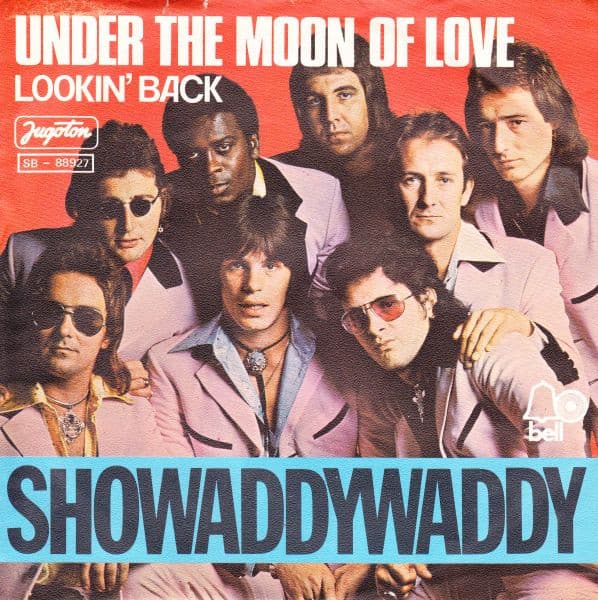
Slow dance beneath borrowed stars, where innocence, nostalgia, and longing converge into a single promise of forever.
When Showaddywaddy released Under The Moon Of Love in 1976, the song rose swiftly to Number One on the UK Singles Chart, becoming one of the defining British hits of that year and anchoring its place on the album Showaddywaddy. In an era crowded with glam excess and emergent punk defiance, this record stood apart by looking backward with unashamed tenderness, reviving the spirit of early rock and roll romance for a new generation that seemed quietly grateful for the reminder.
At its core, Under The Moon Of Love is a revival rather than an invention. The song was first recorded in 1961 by Curtis Lee, produced by Phil Spector during his formative, pre Wall of Sound period. Yet it was Showaddywaddy who transformed it from a minor American hit into a British cultural moment. Their version did not merely cover the song. It reframed it. By the mid seventies, nostalgia had become a language of its own, and Showaddywaddy spoke it fluently, dressing the past not as parody but as living memory.
Lyrically, the song is disarmingly simple. There is no irony in its declaration of young love, no self consciousness in its faith that a single night beneath the moon can seal a lifelong bond. The moon itself becomes more than scenery. It is a witness, a silent keeper of promises made in hushed voices and hopeful hearts. This simplicity is precisely where the song draws its power. In a pop landscape often driven by complexity or rebellion, Under The Moon Of Love insists that sincerity is enough.
Musically, Showaddywaddy lean into doo wop harmonies and a gently rolling rhythm that mimics the sway of a slow dance. The handclaps and backing vocals evoke school halls, community dances, and seaside ballrooms, places where romance once unfolded without spectacle. Dave Bartram’s lead vocal carries a sense of earnest conviction rather than theatrical flourish, grounding the song in emotional truth. It sounds less like performance and more like confession.
What gave Under The Moon Of Love its lasting resonance was timing. By 1976, Britain was restless and fragmented, and the past offered a kind of refuge. This song did not demand that listeners return to the early sixties. It simply invited them to remember what it felt like to believe in love without conditions or consequences. In doing so, it bridged generations, allowing parents and children to share the same melody, the same sentiment, and perhaps the same memory.
Today, Under The Moon Of Love endures not because it is clever or groundbreaking, but because it is emotionally honest. It preserves a version of romance that feels increasingly rare, one rooted in patience, devotion, and shared silence beneath an open sky. Like the moon it celebrates, the song reflects light from another time, still bright enough to guide those willing to look up and listen.