
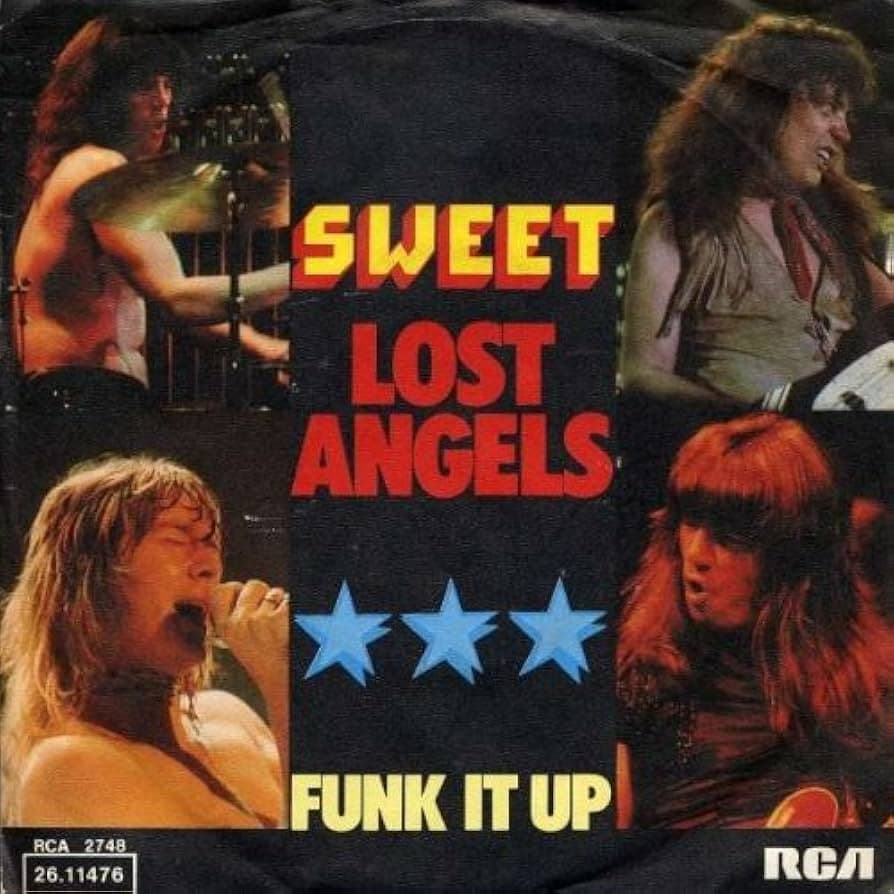
A defiant burst of rhythm and swagger that captures a band refusing to be boxed in by its own success
Released in 1976, Funk It Up arrived as a UK Top 20 hit, climbing to number 13 on the singles chart and signaling a sharp turn in attitude for Sweet. Issued from the album Give Us a Wink, the song stood at a crossroads in the band’s career, appearing just as they were shedding the last remnants of their glam caricature and stepping forward as a leaner, tougher rock outfit. By the time the needle first touched vinyl, Sweet were no longer content to be remembered only for glitter, hooks, and chart friendly choruses. Funk It Up was a statement of intent, pressed loudly and without compromise.
The song emerges from a period when Sweet were actively reclaiming control of their identity. Earlier in the decade, their public image had often overshadowed their musicianship, yet behind the platform boots and flamboyant styling stood a band with serious instrumental firepower. On Funk It Up, that fire is allowed to burn freely. The track opens with a sinewy bass line and a clipped, aggressive groove that owes more to hard rock and emerging funk rhythms than to bubblegum pop. It is danceable, yes, but it is also confrontational, built to push back against expectations.
Lyrically, Funk It Up is deceptively simple. Rather than telling a linear story, it functions as a declaration. The repeated command to “funk it up” becomes a rallying cry, a demand for movement, release, and liberation from stale formulas. This is not funk in the traditional American sense, but a British hard rock band’s interpretation of groove as power. The words serve the rhythm, not the other way around, reinforcing the idea that energy itself is the message.
Musically, the track showcases Sweet at their tightest. Steve Priest’s bass drives the song with muscular confidence, while Andy Scott’s guitar slices through the mix with sharp, economical riffs. Brian Connolly’s vocal delivery is assertive and streetwise, far removed from the sweeter melodies of earlier hits. There is a grit here that reflects a band hardened by touring, criticism, and the constant pressure of reinvention. The production on Give Us a Wink supports this evolution, favoring punch and clarity over gloss, allowing each instrument to claim its space.
In retrospect, Funk It Up occupies an important place in Sweet’s catalog. It may not carry the instant singalong familiarity of their biggest anthems, but it captures something arguably more valuable: a moment of artistic defiance. The song stands as proof that Sweet were not merely reacting to trends, but actively reshaping themselves in real time. Decades later, Funk It Up still pulses with urgency, a reminder that rock music, at its best, is not about comfort or nostalgia, but about motion, risk, and the refusal to stand still.