
A Quiet Reckoning of Loss and Impending Change
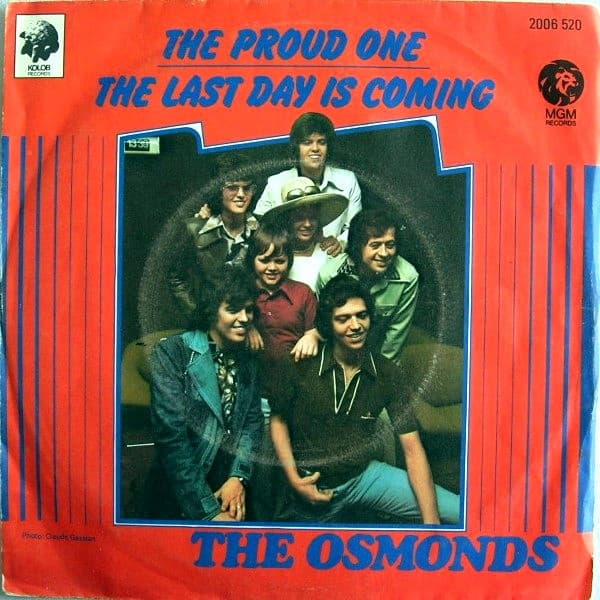
“The Last Day Is Coming” is a deeply melancholy hymn of emotional exhaustion, recorded by The Osmonds as the B‑side to their 1975 single “The Proud One”. Although it was not released as an A-side hit, it lives on in their seventh studio album, The Proud One, a record that marked a subtle but telling shift in the group’s trajectory.
In the mid‑1970s, The Osmonds—once pop wunderkinds—were maturing, both in their sound and their inner lives. The Proud One was released on August 30, 1975 under MGM Records, and though the album only climbed to #160 on the Billboard 200, it remains significant as their final MGM release. The title track, backed by “The Last Day Is Coming,” was itself a commercially modest but emotionally resonant offering—its A‑side reached #22 on the U.S. Billboard Hot 100 and even claimed #1 on the Easy Listening chart.
What gives “The Last Day Is Coming” such weight is its lyrical framing: here is a love song steeped not in hope, but in foreboding. Penned by Donny and Wayne Osmond, the lyrics ask haunting questions: “Where is the sun that gave me light each day? … For the last day is coming, and I don’t know why every song that I’m singing makes me cry.” There’s no triumph here, only a slow unraveling of faith in love’s permanence—and perhaps a resignation that what was once bright may soon fade.
Musically, the song is understated. Its arrangement lets the vulnerability of the lyrics take center stage. The harmonies, always a strength for the Osmond family, are more plaintive than exuberant—brothers blending voices not to uplift, but to softly mourn. The production, overseen by The Osmonds themselves alongside Mike Lloyd, echoes the modest intimacy of the moment: it feels like an unguarded confession rather than a polished pop anthem.
On a deeper level, “The Last Day Is Coming” grapples with existential longing. The “last day” is not necessarily apocalyptic—it may be symbolic, the end of a relationship, or the final moment when things can no longer be repaired. The speaker reaches toward “tomorrow” even as he admits that love may already be slipping away: “Still the love that I’ve given flies away.” There is nostalgia, but also urgency: this is a reckoning, and time feels both infinite and dangerously finite.
In the broader arc of The Osmonds’ career, this track stands as a quietly powerful counterpoint. Their more upbeat singles—bubblegum pop hits, rock‑tinged tracks—were made for radio play. But here, off the B-side, they offer something more intimate: a meditation on loss, change, and the fragile nature of devotion. It’s a song for those moments when you sense a turning point, even if you can’t quite name it yet.
Decades later, “The Last Day Is Coming” remains a hidden gem in The Osmonds’ catalog. It’s not about chart dominance—it’s about emotional truth. For the listener who leans in, it offers a space to sit with uncertainty, hear a family’s vulnerability, and feel the quiet weight of love’s possible end.