
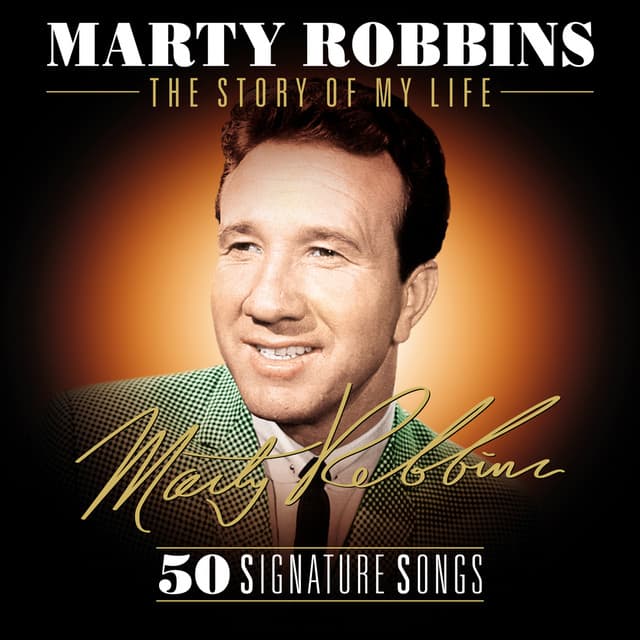
A quiet confession carried in melody, revealing a life shaped by love, longing, and the quiet courage of remembering.
When Marty Robbins released The Story of My Life in 1957, the single quickly rose to the top of the Billboard Country and Western chart, reaffirming his remarkable ability to stand at the crossroads of country, pop, and narrative songwriting. Written by Hal David and Burt Bacharach, and issued as a standalone single rather than part of an album, the song became a cornerstone of Robbins’s late fifties output, marking an early intersection between Nashville craftsmanship and the sophisticated melodic sensibilities that Bacharach would later define. In this recording, Robbins offered something rare in the genre at the time: an autobiographical illusion wrapped in a universal sentiment, shaped by his warm tenor and instinct for emotional clarity.
The heart of The Story of My Life is its subtle architecture. It opens with a gentle melodic rise that mirrors the act of reaching back into memory. Robbins sings with a softness that suggests both vulnerability and acceptance, as if he understands that every recollection is a negotiation between truth and feeling. Rather than detailing specific events, the lyrics unfold as a thematic memoir, where love functions as the guiding force that gives shape to existence itself. Each line becomes a brushstroke painting the atmosphere of a lived experience rather than a literal autobiography. Robbins inhabits the song with a kind of graceful restraint, offering enough sincerity to feel personal while still allowing listeners to find their own reflections within the narrative.
Bacharach’s composition elevates the lyric by blending country phrasing with a gently lilting pop contour, a combination that was quietly revolutionary. The chords move with a lightness that carries Robbins’s voice upward, giving the song an undercurrent of hopefulness even while it meditates on the past. Meanwhile, David’s lyric turns simple statements into emotional anchors. The effect is a song that feels intimate without being small, nostalgic without being sentimental, and deeply personal without revealing a single concrete detail.
What makes the performance endure is Robbins’s instinctive understanding of storytelling. He does not present his life as a series of milestones but as an emotional continuum where love becomes the defining narrative thread. In doing so, he transforms a modest ballad into a universal meditation on how a heart is shaped. It is a reminder that the most powerful stories are not always the grand ones. Sometimes they are simply the ones we feel before we understand.