
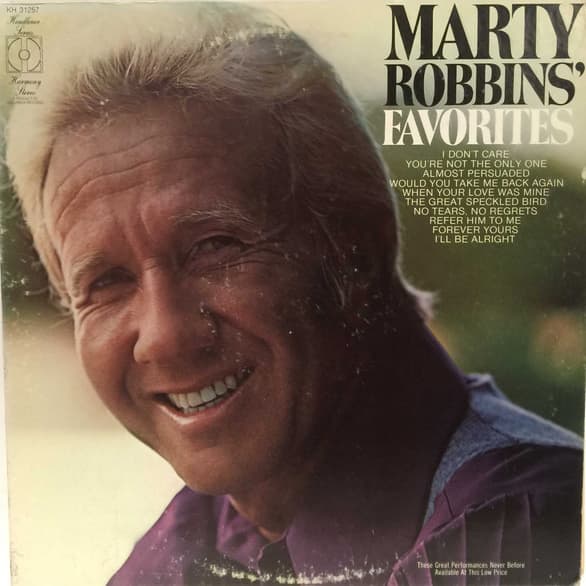
A Baritone’s Quiet Plea for Redemption and Reconnection
“Would You Take Me Back Again” appears on Marty Robbins’ 1967 album My Kind of Country, a deeply personal and vulnerable ballad penned by Bobby Sykes. While it was not released as a standalone single, it occupies a special place in Robbins’s catalog—as a raw confession tucked into an album of soul-stirring country fare.
In My Kind of Country, Robbins leans into his most sincere emotional register. Though the album didn’t produce a blockbuster hit from this particular track, “Would You Take Me Back Again” is emblematic of the mature, reflective side of Robbins’s artistry. The record was released in March 1967. His baritone, ever warm yet tinged with regret, carries the weight of a man grappling with his mistakes and yearning for a second chance.
At its core, “Would You Take Me Back Again” is a song about penitence, longing, and the complex dynamics of a love that has been damaged. Robbins’s narrator is painfully honest from the very first line: “One too many times you left me lonely / Our love to you was take and never give.” It’s not the boastful swagger of a cowboy or the bravado of a drifter—this is a man stripped bare, admitting his failures and asking, with trembling vulnerability, whether his beloved would welcome him back.
Lyrically, Sykes crafts a delicate balancing act. The narrator holds up a mirror to himself—acknowledging that he has caused pain (“If I’d made you live through only half / Of what you put me through”) —yet there is also a desperate hope that his partner’s forgiveness would not be even more conditional or cruel. He wonders whether, if the roles were reversed, she would do the same thing to him. That sense of reciprocity—or lack thereof—runs deep, suggesting that hurt has not just been inflicted, but also mirrored.
Musically, the song is deceptively simple. The chord progression—rooted in G and cycling through softer transitions—underlines the emotional honesty without flashy ornamentation. There are no grand orchestral flourishes, no dramatic tempo shifts: Robbins’s voice remains the centerpiece. His delivery carries a quiet urgency, as though he’s speaking directly into the listener’s ear, in a nearly confessional tone.
In context of Robbins’s legacy, this song reveals an aspect of the Texas-born legend often overshadowed by his story-songs, western ballads, and high drama hits like “El Paso”. By 1967, he was already celebrated for his storytelling and his range as a singer. But here, he sets aside gunfighters and wide-open plains, and confronts something more universal: the fear that one’s love might never be enough, and the frailty of asking for forgiveness.
Emotionally, the song resonates for its timelessness. The question “Would you take me back again?” remains haunting—not just to the narrator, but to anyone who has ever wondered whether love can survive betrayal, selfishness, or repeated hurt. It’s not a triumphant redemption arc; it’s a humble, ongoing plea. The narrator doesn’t promise he’s perfect, only that he’s aware of his flaws—and still hopes for reconciliation.
In the broader tapestry of Robbins’s work, “Would You Take Me Back Again” endures as a poignantly intimate moment. It’s a reminder that even country’s stoic hearts sometimes break, sometimes beg, and sometimes, most powerfully, hope.