
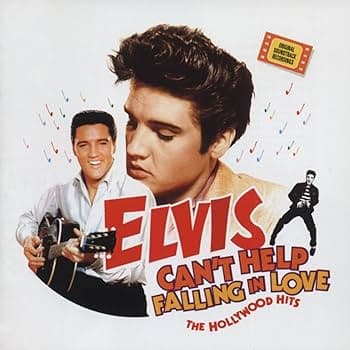
A vow whispered with humility, where surrender becomes the truest form of love.
When Elvis Presley released CAN’T HELP FALLING IN LOVE in nineteen sixty one, the song rose swiftly to number two on the Billboard Hot one hundred and reached number one on the United Kingdom Singles Chart, securing its place as one of the defining love ballads of the era. It appeared on the soundtrack album BLUE HAWAII, a record that itself dominated the charts and reinforced Presley’s position not merely as a cultural phenomenon, but as a vocalist capable of deep restraint and emotional clarity. In a career often defined by excess, movement, and spectacle, this song arrived like a quiet confession spoken after the lights had dimmed.
At its core, CAN’T HELP FALLING IN LOVE is built on inevitability. The melody draws directly from the eighteenth century French love song Plaisir d’amour, a choice that anchors the composition in centuries of romantic longing. This lineage matters. By borrowing from a classical structure associated with fragile devotion and sorrowful beauty, the song immediately signals that this is not infatuation, not desire in passing, but something older and heavier. Love here is not chosen. It is accepted.
The lyrics unfold with remarkable humility. The opening question, asking whether it is wise to rush in, frames love as something that should be resisted, examined, even feared. Yet each line gently dismantles that caution. Like a river flowing surely to the sea, the metaphor does not glorify passion. It normalizes it. Love becomes a law of nature, beyond negotiation or reason. In this framing, surrender is not weakness. It is honesty.
Presley’s vocal performance is essential to the song’s enduring power. He sings softly, almost reverently, allowing space between phrases, trusting silence as much as sound. There is no bravado here. The phrasing is careful, the tone warm and exposed. It is the voice of a man setting down his armor. For an artist so often mythologized as larger than life, this restraint feels intimate, almost private, as though the listener has been allowed into a moment not meant for an audience.
Culturally, CAN’T HELP FALLING IN LOVE has transcended its original context. It has become a ceremonial song, played at weddings, farewells, and final dances. Presley himself would later close concerts with it, turning the song into a benediction offered to his audience night after night. In those final performances, its meaning deepened. It no longer sounded like the beginning of love, but its acknowledgment. The acceptance of something lasting, irreversible, and quietly overwhelming.
What endures is not sentimentality, but truth. The song does not promise happiness. It promises inevitability. Love will come, it will remain, and resistance will only delay what is already written. In that sense, CAN’T HELP FALLING IN LOVE stands as one of Elvis Presley’s most honest recordings, not because it declares passion loudly, but because it admits, with grace and calm certainty, that some things in life cannot be helped.