
A Reckoning Spelled in Sound That Confronts What We Have Done
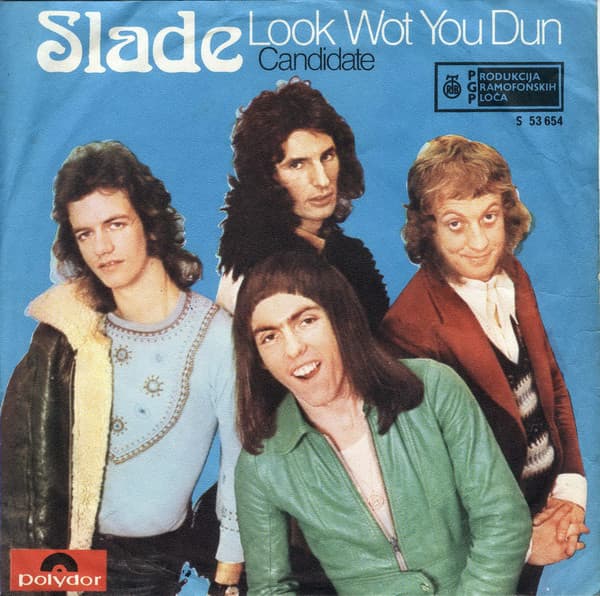
In 1972 Slade captured the restless tension of longing and confrontation with Look Wot You Dun, a song that crystallized the band’s momentum at a moment when glam rock was not just a style but a cultural pulse. Released on 28 January 1972, the single climbed to No. 4 on the UK Singles Chart, where it remained for ten weeks, affirming Slade’s ability to blend irrepressible energy with emotional candor. Although issued as a standalone single, Look Wot You Dun was later anthologized on the 1973 compilation Sladest, a record that gathered the band’s most defining hits.
From the very first chords, Look Wot You Dun stands apart within Slade’s early canon. Its title’s characteristic playful misspelling was more than a gimmick; it was a marker of the band’s ethos, a refusal to conform to orthodoxy in both language and sound. This phonetic boldness provoked bemused protest from British teachers at the time of its release, who feared such spelling might confuse schoolchildren. Yet beneath this cheeky surface lay a deeper emotional core: a raw, candid exploration of accountability, hurt, and the uncomfortable reckoning that follows human connection gone awry.
The song’s origins trace to the collaborative songwriting of Noddy Holder, Jim Lea, and Don Powell, with production by Chas Chandler. Lea and Powell reportedly developed the initial musical framework before presenting it to Holder, whose vocal delivery amplifies the song’s emotional thrust. One of the track’s most distinctive features is Powell’s breathy backing vocal—an unconventional thread that adds an intimate, almost unsettled quality to the chorus. Instrumentally, Look Wot You Dun marries a piano‑rich introduction with propulsive rhythm work, an intentional contrast that reinforces the song’s thematic tension between introspection and urgency, reflection and release.
Lyrically the song is deceptively simple. Lines such as “I know just exactly where to be / You know what my freedom means to me” encapsulate a dialogue not merely with another person but with oneself—an internal negotiation about autonomy, consequence, and the meanings we assign to actions and intentions. Within the broader context of early 1970s rock, where bravado often overshadowed vulnerability, Look Wot You Dun finds its power in nuance rather than bombast. Holder’s rasping voice conveys both defiance and weariness, a synthesis that allows listeners to project their own experiences of relational friction onto the song’s canvas.
Musically, Slade were at a crossroads of styles. They had emerged from the blues-rock soil of the late 1960s into the flamboyant soil of glam, and this track sits at that intersection. The interplay of pounding rhythm, melodic clarity, and textural surprises reveals a band unafraid to expand its sonic palette, even as it held firm to its stomping live energy. The result is a piece that resonates as much with the internal landscape of emotion as with the external landscape of the stage.
Over time Look Wot You Dun has endured beyond its chart placement, remembered by aficionados as a moment when Slade’s songwriting transcended pop immediacy to touch on universal facets of human experience. Its inclusion on Sladest ensured the song would be rediscovered by successive generations, each hearing in its measured urgency a reflection of their own reckonings with what we each have done and what we choose to face.