
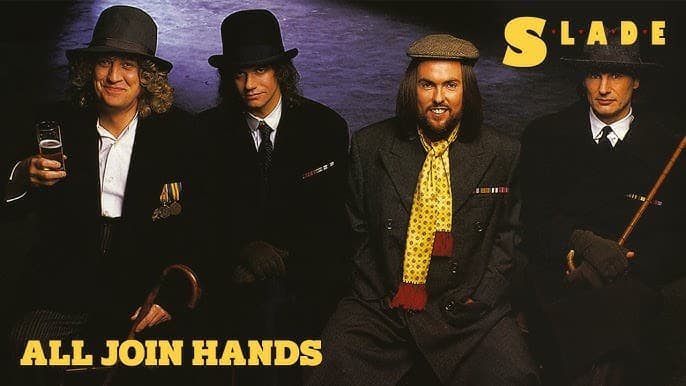
A call for unity that turns the season inward and asks listeners to stand together rather than sing along
Released in late 1984, ALL JOIN HANDS arrived as a UK Christmas single by SLADE, reaching the UK Singles Chart Top 20 during a period when festive releases were expected to deliver cheer, familiarity, and easy sentiment. Issued as a standalone single rather than anchored to a contemporaneous studio album, the song occupies a distinctive place in the band’s catalog, later appearing on compilations that trace SLADE’s evolving identity beyond their early seventies stomping anthems. By this point, the group had already secured their legacy as hitmakers and survivors, and ALL JOIN HANDS reflects a band choosing reflection over bombast, communion over celebration.
What makes ALL JOIN HANDS compelling is not a dramatic origin story but a conscious tonal decision. SLADE, once synonymous with raucous chants and glitter era swagger, instead crafted a song that slows the pulse. The arrangement favors restraint. Keyboards and choral textures dominate the soundscape, creating a gentle, almost hymnal atmosphere. This is not the sound of a band chasing trends or replaying past glories. It is the sound of musicians aware of time, aware of fatigue, and aware that connection sometimes speaks louder when it whispers.
Lyrically, ALL JOIN HANDS avoids the easy tropes of seasonal novelty. There are no lists of decorations, no sleigh bells, no cartoonish imagery. Instead, the song frames unity as a moral choice rather than a festive reflex. The repeated invitation to join hands functions less as a command and more as a quiet appeal. It suggests a world already divided, already bruised, where togetherness must be chosen deliberately. In this sense, the song aligns with a broader early eighties consciousness, when Cold War anxieties and social fragmentation often surfaced in popular music through calls for peace and empathy.
Noddy Holder’s vocal performance reinforces this gravity. His voice, long celebrated for its grit and theatrical power, is tempered here with vulnerability. He sounds less like a ringmaster and more like a witness, someone asking listeners to pause and consider the cost of standing alone. The backing vocals, arranged with near gospel reverence, amplify the sense of collective presence. It feels less like a performance and more like a gathering.
Over time, ALL JOIN HANDS has gained a quiet afterlife. It is not the SLADE song that fills stadiums or triggers instant nostalgia. Instead, it endures as a reflective counterpoint within their body of work, a reminder that even bands built on volume and bravado eventually confront silence and meaning. For listeners willing to meet it on its own terms, the song offers something rare in seasonal music: not escapism, but solidarity.