
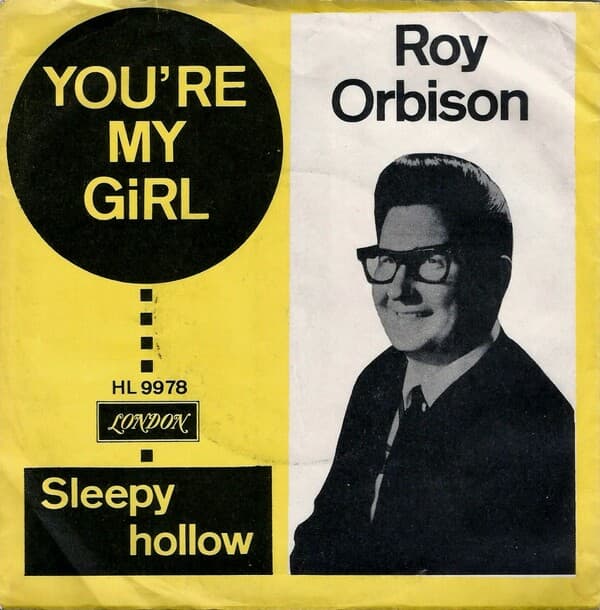
A Quiet Confession of Love Waiting in the Wings
When Roy Orbison released (Say) You’re My Girl in the summer of 1965 it arrived as a subtly powerful single that carried his unmistakable voice into the shifting pop landscape of the mid 1960s. Issued amid a prolific period for Orbison, the song charted on the Billboard Hot 100, peaking at number 39 during a seven-week stay, and reached number 23 in the UK Singles Chart. It was included on the Orbisongs compilation, an album that Monument Records issued in late 1965 as a curated snapshot of Orbison’s output for the label.
In the context of Orbison’s career, (Say) You’re My Girl stands apart from his towering epochal hits such as Oh Pretty Woman and Only The Lonely. Those songs are seismic emotional statements built on dramatic tension and sprawling orchestration. By contrast, this composition unfolds with an intimacy that recalls the teenage yearning at the core of early rock and roll, yet tempered by Orbison’s matured interpretive lens. His vocal delivery is unmistakably poised between hesitant confession and resolute hope, inhabiting a narrative voice that reflects universal uncertainty in love. Here there is no sweeping tragedy or cosmic heartbreak, but rather something quieter: the once-unspoken affection that at last finds its moment of revelation.
The lyrics lay bare a narrative familiar to anyone who has loved from the sidelines. The protagonist, long aware of the object of his affection, finally stands on the precipice of possibility now that her earlier relationship has faltered. Instead of waiting in bitter resentment, he greets her with gentle persistence, inviting a dance and a chance at connection. Lines such as “I still don’t believe it he played around on you” portray not bitterness but disbelief, a wistfulness grounded in emotional vulnerability. That vulnerability is central to Orbison’s artistry: he never makes love seem simple, even when it is expressed in straightforward sentiment.
Musically, the arrangement is unpretentious yet effective. It leans into a mid-tempo groove with rhythmic propulsion that evokes the club and dance hall sensations of its era while allowing Orbison’s voice to remain front and center. Guitar figures and steady backbeat support the lyrical content rather than distract from it, a choice that underscores the conversational nature of the song’s plea. This is not a title that seeks to dominate the airwaves by spectacle; instead it invites the listener into an honest exchange between two people on the brink of something more.
Over time, (Say) You’re My Girl has endured not because it transformed the pop canon but because it reflects a human truth: love often lingers in the spaces between hesitation and declaration. Within Orbison’s broader legacy, the song occupies a niche that reveals his versatility as a storyteller. He could embody cosmic sorrow and ecstatic joy with equal authority, but here he offers a kind of tender anticipation that resonates with anyone who has waited for love to be spoken aloud. Through this lens, the song remains a testament to Orbison’s profound ability to interpret the subtleties of the heart within the evolving soundscape of mid-60s popular music.