
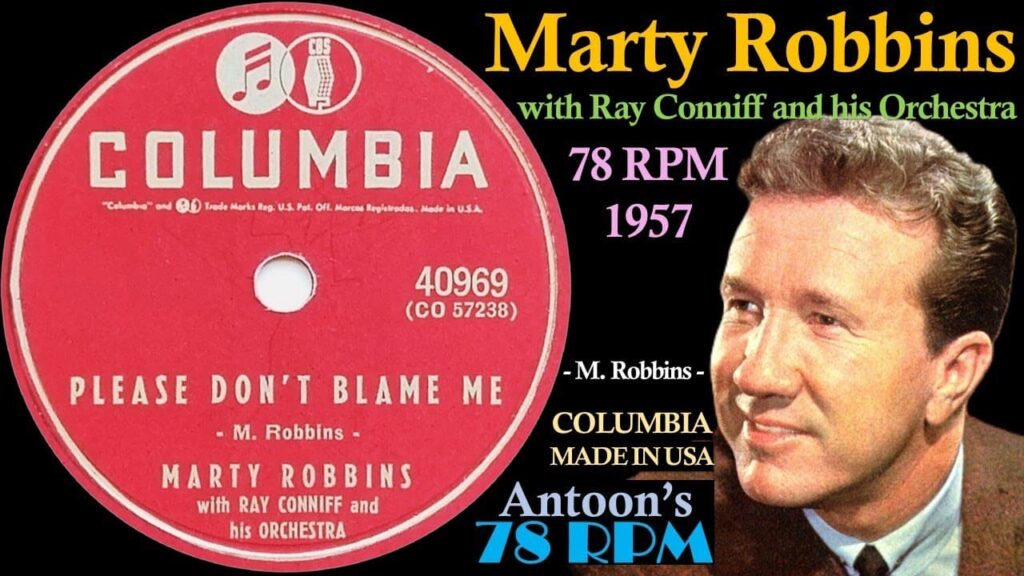
A quiet confession that turns guilt into grace, sung by a voice that knew how to carry regret without spectacle
Released during Marty Robbins’ remarkably fertile Columbia Records era of the early 1957, Please Don’t Blame Me arrived not as a chart-dominating statement but as one of those deeply personal recordings that lived between the grooves rather than on the headlines. It did not register as a major hit on the national charts, yet it found its home within one of Robbins’ studio albums from this period, nestled among performances that favored emotional precision over commercial noise. For listeners who followed Robbins beyond his towering successes, this song revealed another essential facet of his artistry: restraint.
What makes Please Don’t Blame Me endure is not scale, but intimacy. Robbins approaches the song like a man speaking in a dimly lit room, aware that volume would only dilute the truth. His voice carries a gentle weariness, shaped by the understanding that love’s failures are rarely caused by cruelty alone. This is not a plea for absolution wrapped in melodrama. It is a calm acknowledgment of emotional inevitability. The narrator does not deny responsibility, nor does he dramatize his departure. Instead, he asks for understanding, a far more difficult and honest request.
Lyrically, the song belongs to a lineage of mid-century country ballads that treated emotional accountability as a moral act. Robbins does not portray himself as a victim, nor does he villainize the one left behind. The language is measured, almost conversational, allowing the listener to step inside a moment where love has quietly reached its end. The title itself is telling. “Please don’t blame me” is not a demand. It is an appeal rooted in humility, suggesting that some endings occur not from betrayal, but from emotional divergence.
Musically, the arrangement mirrors this emotional posture. The instrumentation remains understated, giving Robbins’ phrasing room to breathe. Each pause matters. Each sustained note feels deliberate. This is the sound of a singer who trusts silence as much as sound. Robbins’ vocal control, honed through years of balancing country, pop, and western storytelling, allows him to convey resignation without bitterness. It is the voice of a man who understands that love can be sincere even when it cannot last.
In the broader arc of Marty Robbins’ legacy, Please Don’t Blame Me stands as a reminder that his greatness was not confined to epic narratives or chart-topping anthems. It lived just as powerfully in these quieter moments, where emotional truth took precedence over spectacle. For the attentive listener, this song offers something rare: a mature meditation on parting that neither accuses nor excuses. It simply tells the truth, softly, and leaves the rest to the heart that hears it.