
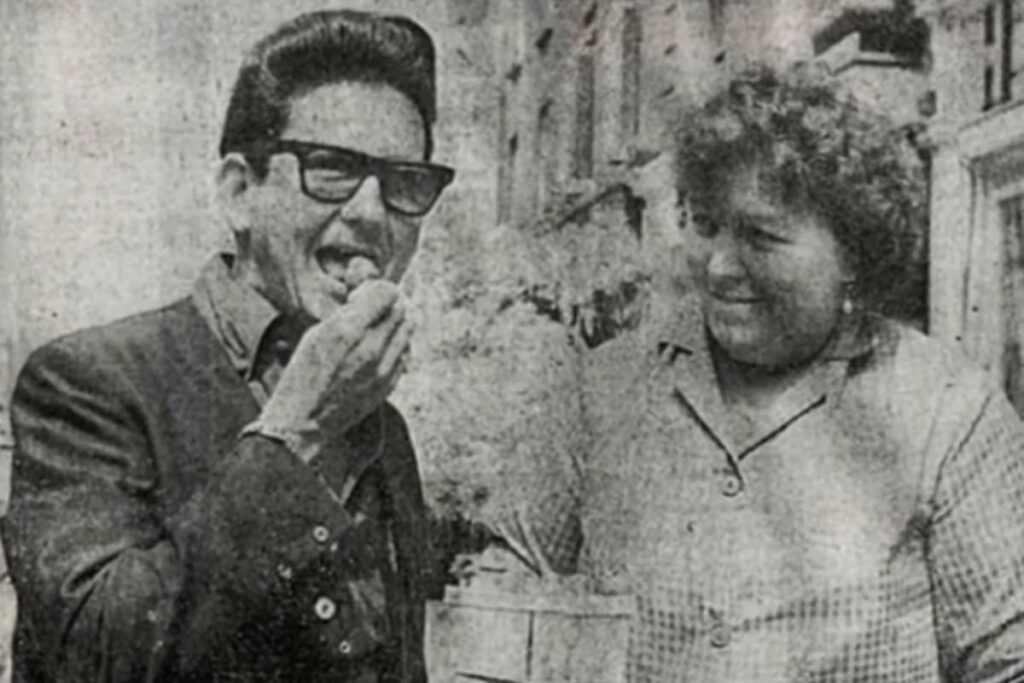
A fleeting glance becomes an eternal longing, where desire and vulnerability collide in a single passing moment
When Roy Orbison released Oh, Pretty Woman in 1964, it quickly ascended to the top of the charts, reaching No. 1 on the Billboard Hot 100 and dominating international rankings, including the UK Singles Chart. Though not originally tied to a studio album upon release, it would later become inseparable from the identity of Roy Orbison, a defining piece in the canon that followed the success of his earlier recordings. His performance of Oh, Pretty Woman on The Ed Sullivan Show transformed the song from a radio triumph into a cultural spectacle, cementing its place in the visual memory of a generation.
What unfolds within Oh, Pretty Woman is deceptively simple on the surface. A man sees a woman walking by. He calls out, half in admiration, half in disbelief. Yet beneath that immediacy lies something far more complex. Orbison does not deliver the lyric with the swagger one might expect from a rock and roll hit of its era. Instead, his voice carries a restrained yearning, a kind of emotional hesitation that reframes the encounter. The woman is not merely an object of desire. She becomes almost mythical, a figure of unattainable beauty drifting through the ordinary world.
Musically, the song is anchored by one of the most recognizable guitar riffs in popular music history, a sharp, rhythmic figure that feels both grounded and urgent. It propels the listener forward, mimicking the heartbeat of sudden attraction. Yet as the verses unfold, the arrangement subtly shifts. Orbison’s vocal phrasing introduces space, allowing silence to linger between lines, as if the narrator himself is unsure whether to speak or remain frozen in awe.
The performance on The Ed Sullivan Show adds another layer of meaning. Standing still, dressed in black, with his signature dark glasses concealing his eyes, Roy Orbison becomes an enigmatic presence. Unlike many of his contemporaries, he does not rely on physical movement to command attention. His stillness becomes its own form of intensity. The audience is drawn not to spectacle, but to the voice, that extraordinary instrument capable of balancing strength and fragility within the same phrase.
Lyrically, the turning point arrives in the closing lines, when the narrative shifts from distant admiration to a moment of unexpected reciprocity. The possibility that the “pretty woman” might turn around introduces a fragile hope. It is a subtle but powerful transformation. What begins as an almost one-sided longing evolves into the faint suggestion of connection, however brief.
Decades later, Oh, Pretty Woman endures because it captures something universally recognizable. Not the certainty of love, but the instant before it begins. The risk of reaching out. The vulnerability of being seen. In that fleeting exchange, Roy Orbison gives voice to a moment that exists outside of time, where desire, doubt, and hope all converge in a single heartbeat.