
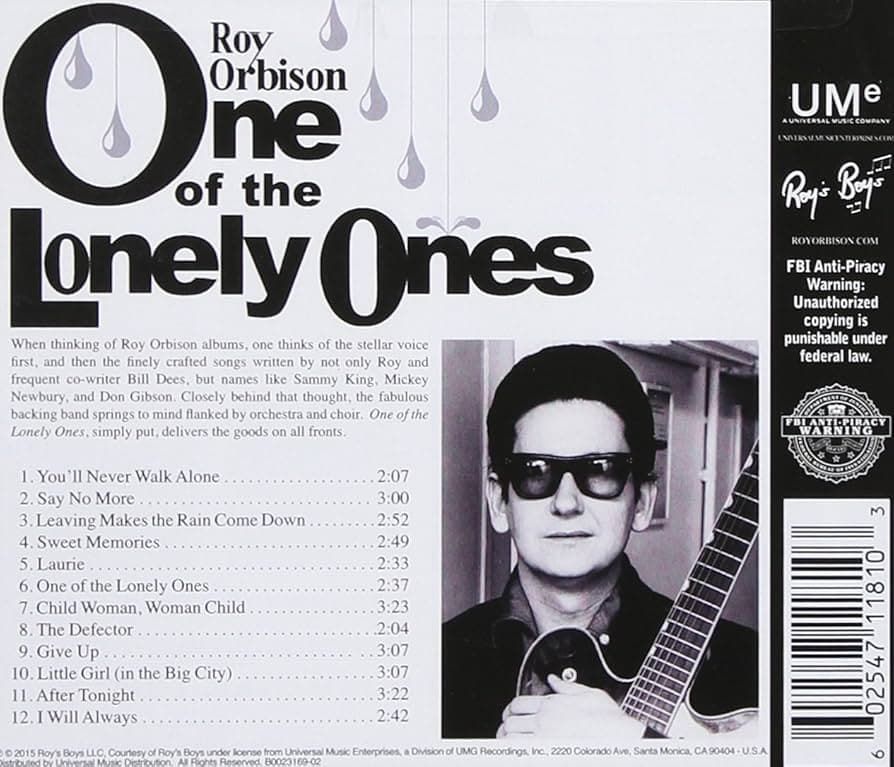
A voice suspended between longing and isolation, where love exists only as an echo in the dark
In the vast, emotionally charged catalog of Roy Orbison, few recordings capture his singular gift for expressing solitude as poignantly as One of the Lonely Ones. Associated with the era surrounding his 1962 album Crying, the song reflects a period when Orbison’s presence on the charts was formidable, with multiple releases consistently reaching the upper tiers of the Billboard rankings. While One of the Lonely Ones itself did not emerge as one of his most commercially dominant singles, it exists within that same creative peak, shaped by the unmistakable sonic architecture that defined Orbison’s early 1960s work.
There is a particular stillness that inhabits this recording. Unlike the dramatic crescendos of Only the Lonely or the operatic sweep of Crying, One of the Lonely Ones feels more internalized, almost whispered from the shadows rather than projected from a grand stage. It is here that Orbison’s interpretive brilliance reveals itself most clearly. He does not merely sing about loneliness. He embodies it, allowing silence and restraint to become as expressive as melody.
The song’s lyrical perspective is deceptively simple. A man acknowledges his place among the forgotten, the overlooked, the emotionally displaced. Yet beneath that simplicity lies a deeper existential current. This is not a temporary heartbreak. It is an identity. To be “one of the lonely ones” is to accept a kind of permanence, a quiet resignation that love may always remain just beyond reach. Orbison’s delivery reinforces this notion with extraordinary subtlety. His voice does not break in anguish. Instead, it hovers, controlled and distant, as if the pain has already settled into something familiar.
Musically, the arrangement mirrors this emotional landscape. The instrumentation avoids excess, favoring space over density. Gentle rhythms and understated backing create a sonic environment where Orbison’s voice can linger. That space is crucial. It allows the listener to feel the weight between phrases, the unspoken thoughts that stretch beyond the lyrics themselves. In many ways, the song operates as a study in restraint, demonstrating how less can often reveal more.
Understanding Roy Orbison’s artistry during this period also requires acknowledging his unique position within early 1960s popular music. While many contemporaries leaned into swagger or youthful exuberance, Orbison cultivated vulnerability as a defining aesthetic. He stood apart, not by competing with the energy of the era, but by offering something profoundly different. Songs like One of the Lonely Ones exemplify that divergence. They invite introspection rather than excitement, contemplation rather than escape.
Over time, the song has taken on a quiet legacy. It may not command the immediate recognition of his most celebrated hits, yet it resonates deeply with those who seek the more intimate corners of his discography. It is within these less heralded recordings that Orbison’s emotional precision becomes most apparent.
One of the Lonely Ones ultimately endures as a testament to a rare artistic truth. Loneliness, when expressed with honesty and grace, does not isolate the listener. It connects them.