
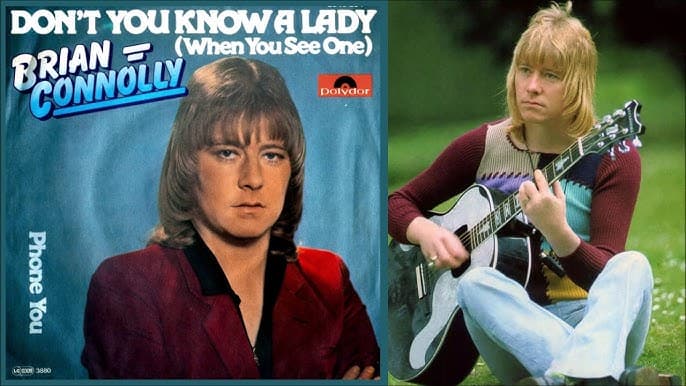
A fragile voice echoing through time, carrying both the fire of youth and the quiet ache of a fading legend
Within the scattered, often overlooked recordings that orbit the legacy of Brian Francis Connolly, the piece known as Tribute Red Hair Rage Demo occupies a deeply intimate space. Connolly, best remembered as the unmistakable voice of Sweet and the driving emotional force behind Desolation Boulevard, once stood at the pinnacle of glam rock success, with chart-topping singles that defined an era. Yet this demo recording belongs to a later, more fragile chapter of his artistic journey, far removed from the glitter and theatrical excess that first brought him acclaim.
What makes Tribute Red Hair Rage Demo so compelling is not its polish, nor its place in commercial history, but its stark honesty. This is not a track built for radio, nor designed to capture charts or trends. Instead, it feels like a document of survival, a moment where Connolly’s voice—once soaring with youthful bravado—grapples with the weight of time, experience, and personal struggle. The title itself suggests a duality: the fiery image of red-haired intensity set against the notion of tribute, of looking backward, perhaps even reconciling with one’s own past.
By the time of recordings such as this, Brian Francis Connolly had endured significant personal and professional upheaval. His departure from Sweet and subsequent battles had altered not only the trajectory of his career but also the texture of his voice. That transformation becomes central to the listening experience. Where once there was clarity and flamboyant precision, here there is grit, strain, and an almost conversational vulnerability. It is precisely this imperfection that lends the demo its emotional gravity.
Musically, the structure of Tribute Red Hair Rage Demo leans toward minimalism. The arrangement—likely skeletal by design—allows the listener to focus on the raw interplay between melody and voice. Without the layered production that defined Sweet’s biggest records, Connolly is exposed in a way that feels almost unguarded. Each phrase carries a sense of immediacy, as though it were captured in a single breath, unfiltered and uncorrected.
Thematically, the song resonates as a meditation on identity and endurance. There is a sense of reckoning embedded in its tone, as if Connolly is confronting both the myth that surrounded him and the reality that followed. The “rage” implied in the title does not erupt in theatrical outbursts but simmers beneath the surface, restrained and introspective. It is the kind of emotional undercurrent that speaks more through hesitation than through volume.
In the broader context of rock history, recordings like Tribute Red Hair Rage Demo serve as crucial counterpoints to the polished narratives of fame. They remind us that behind every era-defining voice lies a human story, often marked by reinvention, loss, and quiet persistence. For listeners willing to lean in, this demo offers something far more enduring than spectacle. It offers truth, unvarnished and deeply felt, preserved in the fragile timbre of a voice that once shook arenas and now whispers its final reflections into the ether.