
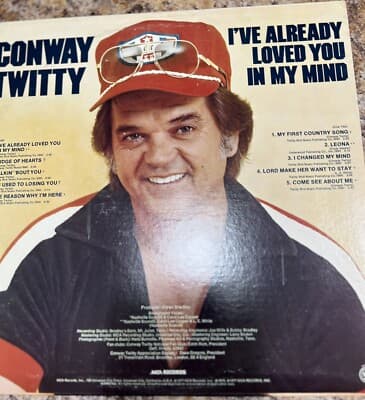
A quiet plea for love that lingers in the spaces pride cannot reach
Within the long and storied career of Conway Twitty, Come See About Me emerges not as a chart-defining juggernaut, but as a deeply expressive moment nestled in his expansive catalog of romantic confessionals. Recorded during a period when Twitty had already solidified his dominance on the country charts through albums like Hello Darlin’, the song reflects the mature phase of an artist who no longer needed commercial spectacle to validate emotional truth. Its presence in his repertoire speaks less to numerical success and more to interpretive depth—a hallmark of Twitty’s enduring legacy.
Originally popularized in a different musical context, Come See About Me takes on a transformed identity in the hands of Conway Twitty. Where earlier renditions leaned into a brighter, almost pleading urgency, Twitty reshapes the song into something slower, heavier, and far more introspective. His baritone voice, unmistakably intimate, does not beg—it confesses. Each line feels measured, as though weighed against the cost of vulnerability. The result is a performance that trades youthful insistence for seasoned longing.
What makes this interpretation so compelling is Twitty’s instinctive understanding of emotional restraint. He does not rush the narrative. Instead, he allows silence and phrasing to carry equal weight with the lyrics themselves. The plea at the heart of Come See About Me becomes less about immediate reconciliation and more about the quiet hope that someone, somewhere, still cares enough to return. It is a subtle but powerful shift in perspective—one that transforms the song into a meditation on distance, pride, and the fragile architecture of love.
Musically, the arrangement complements this emotional recalibration. The instrumentation is understated, often built around gentle steel guitar accents and a steady rhythm section that never intrudes upon the vocal. This sparseness creates space—space for memory, for regret, for the listener to inhabit the emotional landscape Twitty so carefully constructs. It is within that space that the song breathes most fully.
There is also a broader cultural resonance at play. By the time Conway Twitty approached material like Come See About Me, country music itself was evolving, absorbing influences while still holding fast to its core themes of heartbreak and devotion. Twitty stood at the intersection of tradition and interpretation, capable of taking a familiar composition and reframing it through the lens of lived experience. His version does not overwrite the song’s origins; it deepens them.
Listening now, one is struck not by grand gestures, but by the absence of them. Come See About Me becomes a study in emotional economy—how much can be conveyed with so little. In Twitty’s hands, love is not declared loudly. It is revealed slowly, almost reluctantly, in the spaces between words.