
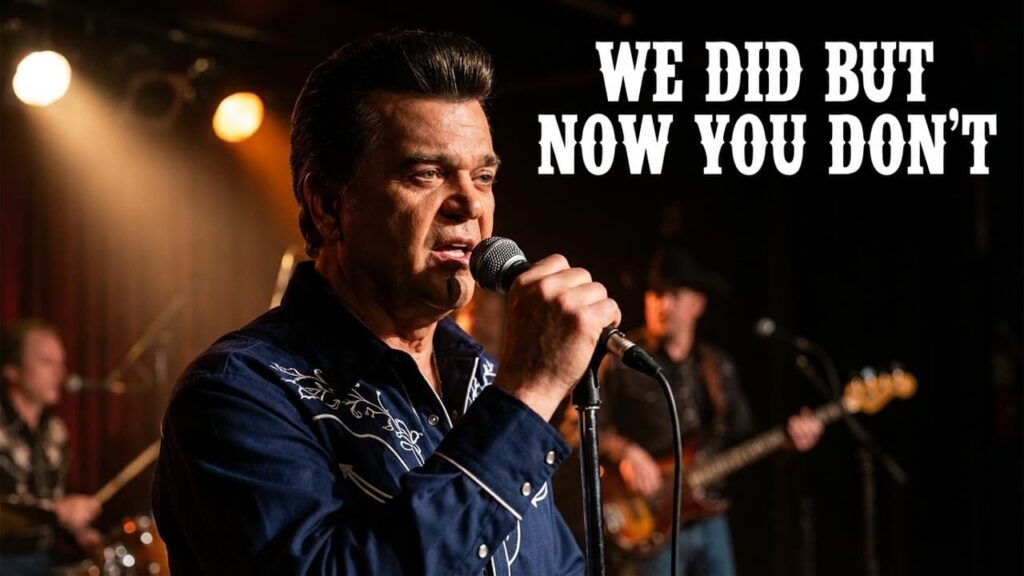
A quiet reckoning where love fades not with drama, but with the slow, unmistakable withdrawal of feeling
By the early 1980s, Conway Twitty had refined his role as one of country music’s most perceptive interpreters of romantic complexity, and We Did But Now You Don’t, from the album Southern Comfort, reflects that mastery with understated precision. While the song did not emerge as one of his most dominant chart-topping singles, it exists within a period where Twitty’s presence on the country charts remained remarkably consistent. More importantly, it exemplifies his ability to transform even the simplest lyrical premise into something emotionally layered and quietly devastating.
At its core, We Did But Now You Don’t is built upon contrast. The past and the present, closeness and distance, certainty and doubt. The title itself reads like a confession stripped to its essence, a single line that contains an entire emotional history. In typical Conway Twitty fashion, the song does not rely on elaborate storytelling. Instead, it distills the experience of a relationship’s unraveling into a few carefully chosen sentiments, allowing the listener to fill in the spaces between.
What makes the song particularly affecting is its restraint. There is no dramatic confrontation, no explosive moment of betrayal. The loss here is quieter, more insidious. It is the realization that something once shared has gradually disappeared, not through a single event, but through a series of small, almost imperceptible changes. Twitty understands this emotional terrain intimately. His delivery does not accuse. It observes.
Musically, the arrangement reflects the smooth, polished country sound that defined much of his work during this period. Gentle instrumentation supports the vocal without drawing attention away from it. The rhythm is steady, almost unchanging, reinforcing the sense of inevitability that runs through the song. There is no urgency in the tempo, no attempt to dramatize the emotion. Instead, the music mirrors the quiet resignation embedded in the lyric.
Vocally, Conway Twitty delivers one of his most nuanced performances. His phrasing carries a subtle weariness, a sense that the realization he is expressing has already settled in. He does not push the emotion outward. He allows it to remain contained, which in turn makes it more powerful. Each line feels measured, as though he is choosing his words carefully, aware that too much emphasis might distort the truth he is trying to convey.
Lyrically, We Did But Now You Don’t explores a universal yet often underrepresented aspect of love. The gradual fading of feeling. It acknowledges that relationships do not always end in dramatic fashion. Sometimes, they simply change, leaving one person still holding onto something the other has already released. This perspective gives the song a quiet authenticity, making it resonate beyond the specifics of its narrative.
Within the broader scope of Conway Twitty’s catalog, the song stands as a testament to his ability to find depth in simplicity. He did not need grand gestures or complex metaphors to communicate emotional truth. A single line, delivered with sincerity, was often enough.
What lingers after We Did But Now You Don’t fades is not a sense of closure, but of recognition. The understanding that love can slip away without warning, leaving behind only the memory of what once was. And in that stillness, Conway Twitty offers no solutions, only the quiet dignity of acceptance.