
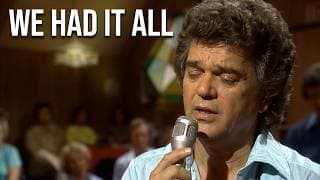
A voice looking back through the ruins of love, finding beauty in what could never be held
By 1981, Conway Twitty stood at the height of his interpretive powers, a seasoned storyteller whose voice had become synonymous with country music’s most intimate confessions. His live performance of We Had It All, a song originally written by Donnie Fritts and Troy Seals, draws not from a specific album cycle or chart campaign of that moment, but from a lineage of recordings that had already secured the song’s emotional legacy. Twitty’s rendition does not seek commercial validation. Instead, it transforms the stage into a space of reflection, where memory itself becomes the central narrative.
There is a particular weight to We Had It All that distinguishes it from the more declarative heartbreak songs of its era. It is not driven by betrayal or dramatic rupture. Rather, it is shaped by hindsight. The song exists in the quiet aftermath, where clarity arrives too late to change anything. In Twitty’s hands, this perspective becomes almost palpable. He does not rush the phrasing. Each line is delivered as though it carries the burden of lived experience, as though the story being told is not merely remembered, but relived.
The live setting of 1981 adds a crucial dimension to the performance. Conway Twitty was an artist deeply attuned to his audience, and here, that connection becomes part of the song’s architecture. The pauses between lines, the subtle shifts in tone, even the restrained instrumentation all contribute to a sense of shared space. It is as if the audience is not simply listening, but participating in the act of remembrance.
Vocally, Twitty navigates the song with remarkable control. His delivery avoids excess, favoring nuance over display. There is strength in his restraint, a refusal to overstate emotion that ultimately makes the performance more affecting. When he leans into a phrase, it feels earned. When he pulls back, the silence speaks just as loudly. This dynamic interplay between sound and stillness is where the performance finds its deepest resonance.
Lyrically, We Had It All is built upon fragments of a past that can never be reconstructed. Small details, fleeting moments, the kind of memories that linger long after the larger narrative has faded. Twitty understands this implicitly. He treats each image with care, allowing the listener to inhabit those moments rather than simply observe them. The result is a song that feels less like a story being told and more like a life being revisited.
Within the broader context of Conway Twitty’s career, this performance stands as a testament to his ability to elevate material through interpretation alone. He was not merely a singer of songs, but a curator of emotion, selecting and shaping material in a way that revealed deeper truths. We Had It All becomes, in this live context, more than a composition. It becomes a meditation on time, on love, and on the quiet realization that some of life’s most meaningful experiences are also its most fleeting.
What lingers long after the final note is not just the melody, but the feeling of something once complete, now irretrievably past. In that space, Conway Twitty does what he always did best. He does not attempt to reclaim what is gone. He simply honors it, and in doing so, allows the listener to do the same.