
When love slips away at the very moment it feels most essential, absence becomes a presence of its own
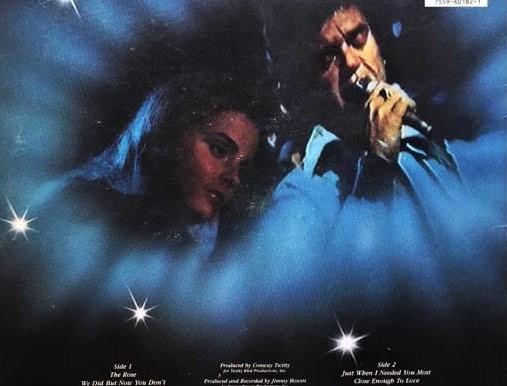
In 1979, Conway Twitty lent his unmistakable baritone to Just When I Needed You Most, a song that had already found major success earlier that year, reaching No. 3 on the Billboard Hot 100. Twitty’s rendition appeared on his album Cross Winds, situating the track within a period when he was seamlessly blending traditional country sensibilities with contemporary pop influences. While not his highest-charting single, his interpretation stands as a testament to his ability to inhabit a song so completely that it feels rewritten in his own emotional language.
The composition itself, written by Randy VanWarmer, is built on a deceptively simple premise. A lover departs without warning, leaving behind not anger or betrayal, but a quiet, devastating vacancy. What Conway Twitty brings to Just When I Needed You Most is not merely technical mastery, but a profound understanding of restraint. He does not overreach. He does not dramatize. Instead, he allows the silence between phrases to carry as much weight as the words themselves.
This is where Twitty’s artistry becomes unmistakable. His voice, seasoned by years of navigating both rock and country landscapes, carries a weary tenderness that feels earned rather than performed. When he delivers the central refrain, there is no sense of accusation. Only a subdued recognition that timing, in matters of the heart, can be mercilessly cruel. Love does not always leave during moments of conflict. Sometimes it vanishes precisely when it is most needed, and that quiet irony is the emotional core of the song.
Musically, the arrangement reflects the late 1970s shift toward smoother, more polished country productions. Gentle acoustic textures, soft percussion, and understated harmonies create a backdrop that never competes with the vocal. In Twitty’s hands, this restraint becomes a narrative device. The song feels intimate, almost confessional, as though the listener has stepped into a private moment rather than a public performance.
There is also a subtle universality embedded within Just When I Needed You Most. The lyrics avoid specifics, allowing listeners to project their own experiences onto the framework of the song. It is not about one particular relationship, but about a shared human vulnerability—the realization that dependence, even when unspoken, can run deeper than we are willing to admit.
Within the broader arc of Conway Twitty’s career, this recording underscores his unique position as a bridge between eras. He possessed the emotional directness of classic country storytelling while embracing the sonic clarity of a more modern sound. Cross Winds may not always be the first album cited in discussions of his legacy, yet moments like this reveal its quiet importance.
What endures in Just When I Needed You Most is not simply its melody or its structure, but its emotional truth. It captures that fragile instant when absence becomes undeniable, when the echo of someone’s presence lingers longer than their voice ever did.