
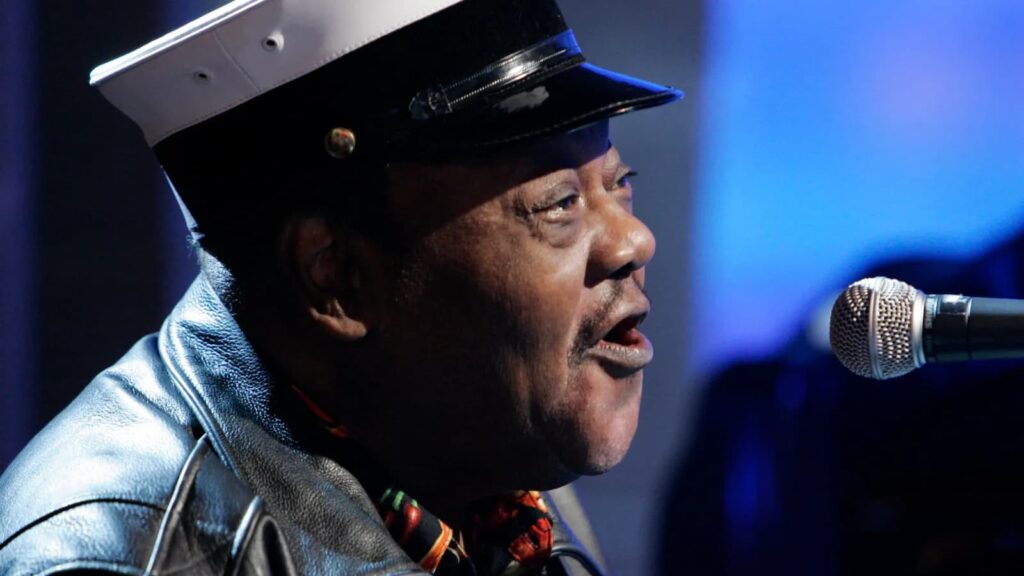
A joyful architect of rock and roll returning not as a relic of the past, but as the heartbeat that still keeps the music alive
When Fats Domino appeared at the Concert for UNICEF, also known as Legends Of Rock ’n Roll, on November 17, 1988, the performance carried a significance far greater than a standard reunion showcase. By then, Domino’s influence had already stretched across generations of popular music. Long before arena rock, MTV spectacle, or modern pop production, his rolling piano rhythms and warm vocal delivery had helped define the foundation upon which rock and roll itself was built. The concert was not tied to a new album campaign or chart resurgence. It was a recognition of legacy, a gathering that acknowledged the enduring architects of American popular music.
Yet what makes Fats Domino’s appearance so compelling is how little he seemed concerned with legacy in the abstract. While others may have viewed him as a pioneer, Domino approached performance with the same unforced ease that defined his earliest recordings. This quality had always separated him from many of his contemporaries. He never appeared to chase greatness. He simply embodied it naturally, through rhythm, warmth, and instinctive musical joy.
The setting of the Concert for UNICEF added an additional emotional dimension. Charity concerts often carry an atmosphere of reflection, where music becomes intertwined with broader human concerns. In that context, Domino’s presence felt almost symbolic. His music had always possessed an inclusive spirit, crossing racial, cultural, and generational boundaries with remarkable ease. Few artists represented the communal origins of rock and roll more authentically.
Musically, the performance reaffirmed the essential qualities that made Fats Domino so influential. The piano remained central, not as a decorative instrument, but as the engine driving the music forward. His playing retained that unmistakable New Orleans pulse, rooted equally in rhythm and blues, boogie-woogie, gospel, and jazz. The groove felt effortless, yet deeply disciplined. This balance between looseness and precision became one of the defining characteristics of early rock and roll itself.
Vocally, Domino’s delivery remained wonderfully human. He never relied on dramatic flourishes or overpowering intensity. Instead, his voice carried warmth, humor, and calm assurance. Even in 1988, decades removed from his commercial peak, that quality endured. Listening to him perform was less like hearing someone revisit old material and more like hearing the music continue exactly where it had always belonged.
There is also something profoundly moving about seeing Fats Domino within the framework of a “Legends” concert. By the late 1980s, many artists influenced by him had themselves become icons. Yet Domino’s presence served as a reminder that beneath the evolving styles of rock music remained a simpler foundation built on rhythm, melody, and emotional accessibility. Without his contributions, the entire landscape of modern popular music would sound different.
What lingers after the performance is not merely nostalgia for rock and roll’s early days, but admiration for the spirit that created it. Domino’s music never depended on rebellion alone. It thrived on joy, connection, and movement. Even decades later, those qualities remained intact.
And standing before the audience at the Concert for UNICEF, Fats Domino did not appear as a distant historical figure being honored for past achievements. He appeared exactly as he always had. Relaxed, smiling, and completely at home inside the rhythm that helped change the world.