
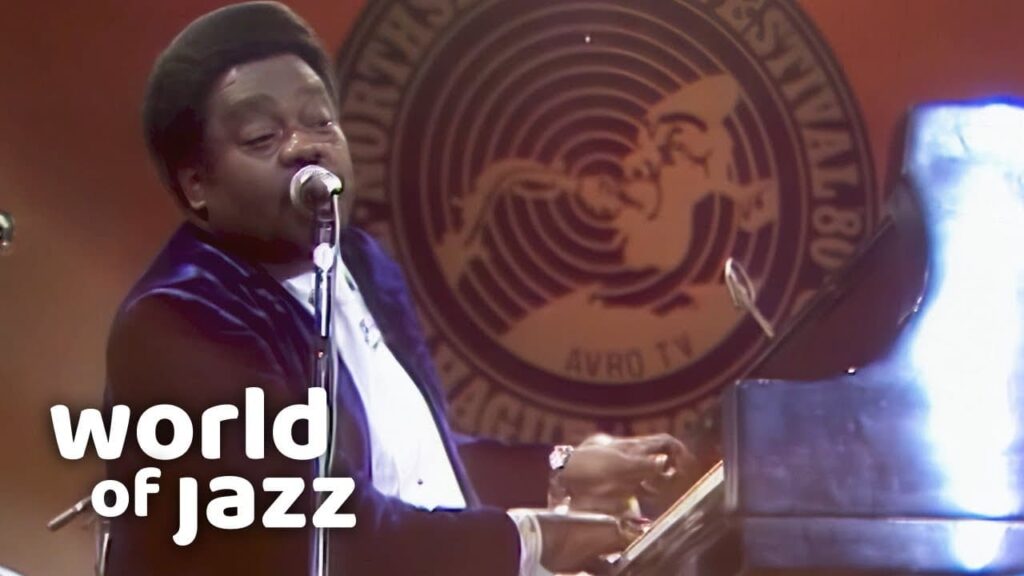
A joyful storm of rhythm and memory where the foundations of rock and roll still pulse with unstoppable life
By the time Fats Domino appeared at the North Sea Jazz Festival in July 1980 for the televised performance often associated with Rhythm Blues Explosion, he was no longer simply a hitmaker from another era. He had become living history. Decades earlier, Domino had helped shape the very architecture of rock and roll through landmark recordings like Blueberry Hill, Ain’t That a Shame, and I’m Walkin’, songs that crossed racial and musical boundaries with effortless warmth. The performance at the festival was not tied to a new chart campaign or contemporary commercial resurgence. Instead, it functioned as something far more enduring. A celebration of a man whose music had already altered the course of popular culture.
What makes this appearance particularly compelling is the setting itself. The North Sea Jazz Festival, known for honoring improvisation, musicianship, and legacy, provided the perfect backdrop for Domino’s style. Though often categorized under early rock and roll or rhythm and blues, his music had always contained the looseness and swing associated with jazz traditions. Watching Fats Domino perform in this environment reveals how naturally his sound belonged there.
The title Rhythm Blues Explosion feels especially fitting because the performance radiates momentum from the very beginning. Domino does not approach the stage with theatrical spectacle or dramatic intensity. His power comes from rhythm itself. The rolling piano lines, the relaxed but unshakable groove, and the infectious sense of joy create an atmosphere that feels immediate and communal. This was always the essence of Fats Domino. He never forced excitement. He generated it naturally.
Vocally, Domino remained unmistakable in 1980. His warm, easygoing delivery carried the same approachable humanity that had defined his earliest records. There is no sense of strain or overstatement in his singing. Instead, his voice moves through the songs with calm confidence, allowing the rhythm to do much of the emotional work. This understated quality is precisely what made him so influential. While many performers sought to overwhelm audiences, Domino invited them in.
Musically, the live setting enhances the organic nature of his sound. The band swings with looseness but never loses precision, creating the feeling of a conversation rather than a rigid arrangement. The piano remains central, not merely as accompaniment, but as the heartbeat of the performance. Domino’s playing retains its rolling New Orleans character, deeply rooted in blues, boogie-woogie, and early jazz traditions.
Beyond the technical performance, there is a deeper cultural resonance to this concert. By 1980, many of the artists influenced by Fats Domino had already become legends themselves. Yet here he stood, still embodying the original spirit from which so much modern music emerged. The performance becomes more than entertainment. It becomes preservation. A reminder of where the music came from before stadium excess, before heavy production, before spectacle overtook simplicity.
What lingers after the performance ends is not nostalgia alone, but vitality. The realization that truly foundational music does not age in the same way trends do. It continues to move, to breathe, and to connect.
And in that enduring rhythm, Fats Domino remains exactly what he always was. Not merely a pioneer looking back at history, but a living pulse at the center of it.