
Sometimes the Smallest Heartbreaks Leave the Deepest Stains
When Showaddywaddy released “A Little Bit Of Soap” in the summer of 1978, the record climbed to No. 5 on the UK Singles Chart and became one of the defining hits of the group’s remarkable late-1970s run. First performed to millions during their appearance on Top of the Pops on 22 June 1978, the song would later find a lasting home on Greatest Hits 1976–1978, the compilation that captured the band at the peak of their commercial powers. Yet behind the polished harmonies, teddy-boy swagger, and nostalgic rock ’n’ roll revivalism lay something far more fragile: a song about the futility of trying to wash away memory itself.
What made “A Little Bit Of Soap” endure was not merely its catchy refrain, but the contradiction beating at its center. The lyric sounds deceptively simple — a man standing before a sink, convinced that soap and water might somehow erase the traces of a lost love. But the genius of the song has always been its understanding that heartbreak is never physical. You can wash your hands, clean your face, change your clothes, leave the city, even rebuild your life, yet the emotional imprint remains untouched. In the hands of Showaddywaddy, that old doo-wop lament became something both joyful and quietly devastating.
The band had already built their reputation on reviving the spirit of 1950s and early-1960s rock ’n’ roll for a new generation. By 1978, Britain was changing rapidly. Punk had arrived with confrontation and noise; disco ruled dance floors with glitter and excess. Yet Showaddywaddy continued to thrive because they offered something timeless: melody, innocence, and emotional directness. Their version of “A Little Bit Of Soap”, originally written by Bert Berns and first popularized in the early 1960s, did not attempt to modernize the song beyond recognition. Instead, they leaned into its vintage soul, surrounding it with warm harmonies, rolling rhythm guitar, and an almost theatrical sincerity.
That sincerity is what gives the performance its emotional gravity even today. There is no irony in the vocal delivery. No distance. The narrator truly believes, for a fleeting moment, that pain can be scrubbed away like dirt. The audience knows better, and perhaps the singer does too, but the desperate hope remains painfully human. It is the same emotional territory occupied by the great jukebox ballads of the postwar era — songs where ordinary domestic images suddenly become symbols of loneliness.
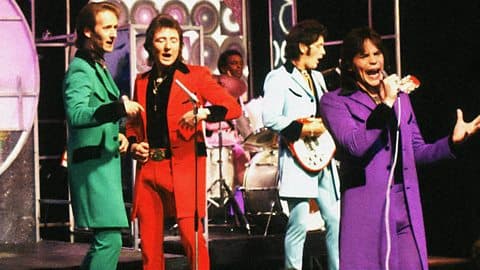
Watching the 1978 television performance now feels like opening a faded photograph from another Britain entirely. The suits, the choreography, the polished smiles — all of it belongs to a world where pop music still carried traces of dancehall romance and street-corner harmonies. Yet the emotional core remains startlingly modern. That is why the song survives beyond nostalgia. Beneath the retro styling lies a universal truth: grief does not disappear simply because we wish it clean.
In many ways, “A Little Bit Of Soap” stands as one of the finest examples of Showaddywaddy’s lasting gift. They understood that rock ’n’ roll was never only about rebellion. Sometimes it was about vulnerability disguised beneath rhythm, harmony, and a bright smile under television lights.