
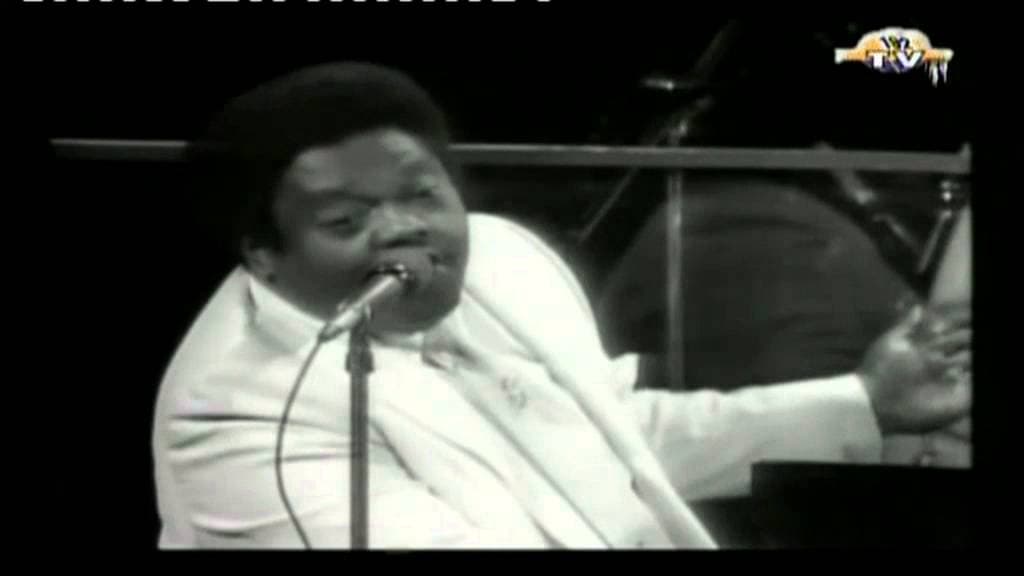
A Working Man’s Lament Wrapped in the Warmth of New Orleans Rhythm
When Fats Domino released “Blue Monday” in 1957, he was already one of the defining architects of early rock ’n’ roll, but this record revealed something deeper than youthful exuberance. Issued as a single and later included on the album This Is Fats Domino!, the song climbed to No. 5 on the Billboard R&B chart and crossed into the pop market at a time when rhythm and blues was still fighting for mainstream acceptance. That achievement mattered because “Blue Monday” did not rely on novelty or rebellion. Instead, it spoke in the weary voice of ordinary laborers — men and women trapped in the repetition of the workweek, living for the brief promise of Saturday night freedom.
Written by Dave Bartholomew and Fats Domino, the song carries the unmistakable pulse of New Orleans rhythm and blues. Bartholomew’s arrangements were never cluttered; they breathed. The horns sway rather than explode, the piano rolls with gentle insistence, and Domino’s voice arrives not with theatrical anguish but with the calm exhaustion of someone who has accepted hardship as a permanent companion. That restraint is precisely what gives the song its emotional authority. Many records of the era shouted their sorrow. “Blue Monday” barely raises its voice.
The brilliance of the lyric lies in its simplicity. Each day of the week becomes another link in a chain of obligation: Monday is unbearable, Tuesday is no better, Wednesday feels endless, and by Thursday and Friday the body is nearly defeated. Yet there is no revolution in the song, no dramatic escape. The weekend appears only as temporary relief, a fleeting breath before the cycle begins again. In that sense, “Blue Monday” stands alongside the great American working-class songs, though it rarely receives recognition in those terms. Beneath its easy groove is a portrait of economic fatigue and emotional endurance.
What makes the record extraordinary is the contradiction at its heart. The music swings. Domino’s piano dances with warmth and almost playful elegance. The rhythm section invites movement. Yet the subject matter is deeply melancholic. That tension — sadness carried by joyful rhythm — became one of the defining emotional signatures of New Orleans music itself. The city’s musical culture has long understood that sorrow and celebration often occupy the same room. “Blue Monday” embodies that philosophy with remarkable grace.
By 1957, rock ’n’ roll was rapidly becoming louder, faster, and more provocative, but Fats Domino remained anchored in a gentler humanism. His records did not threaten the listener; they comforted them. Even in despair, there is kindness in his delivery. He sounds less like a star performing for an audience and more like a man sitting beside you after a long shift, quietly explaining how life feels.
That intimacy is why “Blue Monday” has endured far beyond its chart run. Decades later, the song still resonates because the exhaustion it describes never disappeared. The names of the jobs may change, the cities may change, but the rhythm of obligation remains painfully familiar. And through it all, Fats Domino offers something rare in popular music: empathy without self-pity, sadness without bitterness, and resilience carried on the rolling keys of a New Orleans piano.