
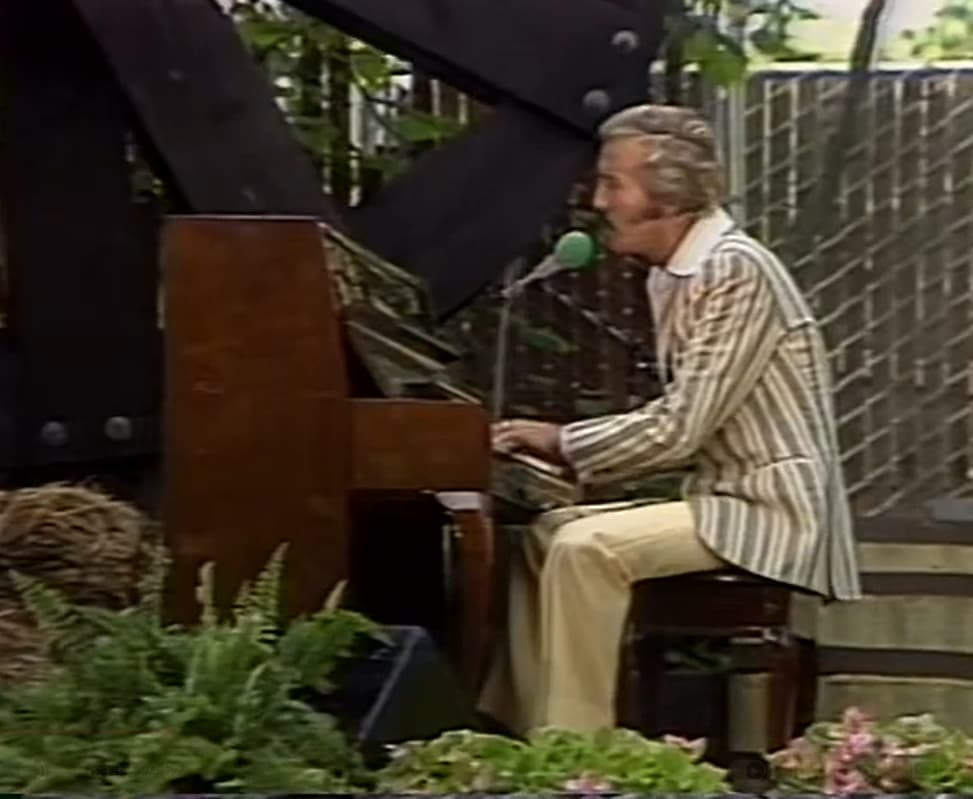
A Cowboy Balladeer Walks Into Another Man’s Living Room and Turns Television Into Memory
By 1980, Marty Robbins was no longer merely a country singer moving through the machinery of Nashville fame—he had become one of the last great guardians of the American storytelling tradition. His appearance on The Porter Wagoner Show that year arrived during a period when country television still carried the intimacy of a front-porch conversation. While this was not a conventional charting single tied to a specific commercial release, the performance itself stands as a revealing late-career document of an artist whose influence had already been cemented through landmark recordings like El Paso, Big Iron, and the albums Gunfighter Ballads and Trail Songs and Marty Robbins’ All-Time Greatest Hits. By the time this broadcast aired, Robbins had already earned multiple No. 1 country records and crossed into pop success in a way few country artists of his generation ever managed.
What makes the full 1980 appearance so compelling is not spectacle, but atmosphere. Porter Wagoner, himself one of country music’s great hosts and traditionalists, created a setting where artists were allowed to sound human rather than manufactured. Robbins stepped into that environment with the calm assurance of a man who no longer needed to prove anything. The voice remained velvet-smooth, but age had added something else: gravity. There is a quiet difference between a young singer performing lyrics and an older artist who has clearly lived inside them.
Watching Robbins in this era is to witness the fading glow of country music before commercial polish overtook emotional truth. He belonged to a generation that understood silence as part of the arrangement. He never rushed a line. He allowed songs to breathe. Even in casual television settings, Robbins carried himself like a cinematic narrator standing at the edge of some dusty Southwestern horizon. That quality had always separated him from many of his contemporaries. While Nashville increasingly leaned toward slick production in the late 1970s and early 1980s, Robbins still sounded tethered to the lonely landscapes that shaped his greatest recordings.
The emotional power of this appearance also comes from hindsight. Modern audiences watch these performances knowing Robbins would pass away only a few years later, in 1982, at the age of 57. That knowledge changes the texture of every smile and every lyric. The show becomes more than entertainment; it becomes preservation. Television in that era was fleeting by design, never intended to be endlessly replayed decades later. Yet these surviving broadcasts now function almost like oral history archives for country music itself.
Robbins’ artistry always rested on restraint. Unlike performers who chased emotional excess, he understood that heartbreak becomes more devastating when delivered softly. Even his most dramatic songs carried elegance rather than theatricality. On The Porter Wagoner Show, that restraint is unmistakable. He sings as though speaking directly to someone sitting a few feet away, not to millions through a camera lens. That intimacy explains why his performances continue to resonate long after trends have faded.
There is also something profoundly symbolic about seeing Robbins beside Wagoner. Together, they represented two pillars of classic country television culture: dignity, narrative songwriting, and emotional sincerity untouched by irony. Their generation treated songs as lived experiences rather than disposable entertainment products. In today’s fragmented musical landscape, these broadcasts feel almost sacred because they capture artists who believed music should reveal character, not merely attract attention.
For many listeners, the 1980 appearance endures because it reminds us that country music once valued wisdom as much as youth. Marty Robbins did not need reinvention. He simply stood under the studio lights, opened his mouth, and let decades of American memory sing through him.