
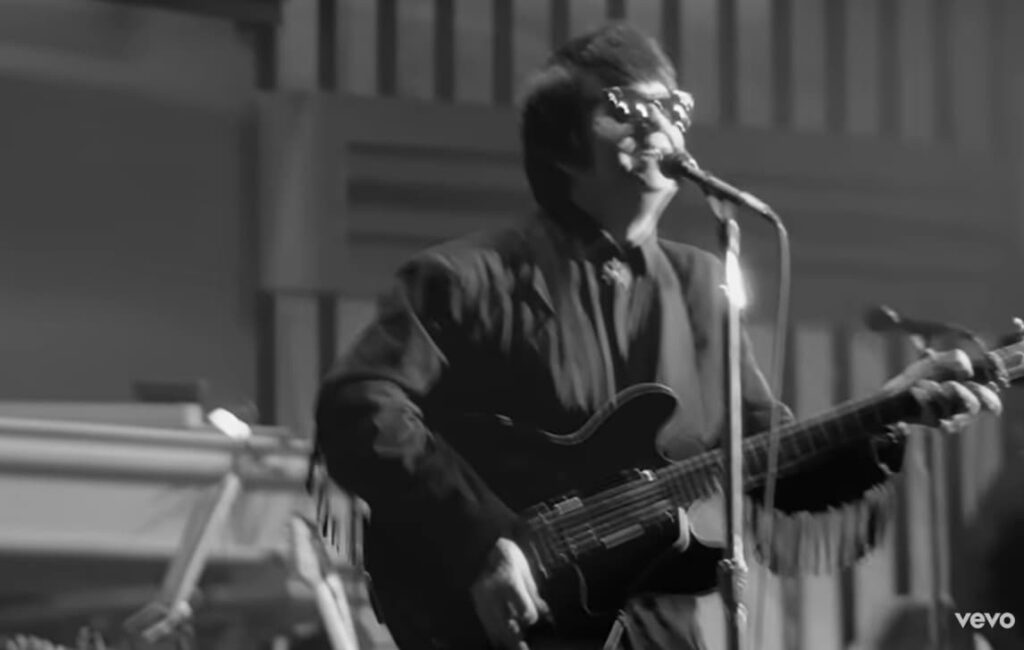
A Night of Reckless Rhythm and Redemption Reborn Under the Spotlight
When Roy Orbison stormed into Go! Go! Go! (Down the Line) during the celebrated television special Black & White Night 30, he was no longer merely revisiting an old rockabilly number — he was reclaiming a forgotten pulse from the earliest days of American rock ‘n’ roll. Originally tied to Orbison’s formative years at Sun Records and later associated with the album Roy Orbison at the Rock House (1961), the song never achieved the towering chart dominance of classics like Only the Lonely or Crying. Yet its appearance in the anniversary edition of Black & White Night transformed it into something richer: a living document of survival, stamina, and musical memory. In that electrified room, backed by an elite assembly of musicians and admirers, Orbison revived the reckless heartbeat of youth with the authority of a man who had already outlived tragedy, reinvention, and near-erasure.
What makes Go! Go! Go! (Down the Line) fascinating is how far it stands from the image many listeners hold of Orbison. The public often remembers him as the grand architect of loneliness — the operatic voice draped in heartbreak and shadow. But before the orchestral sorrow, before the dark glasses became iconic mythology, Orbison was a hungry Texas rocker intoxicated by rhythm, velocity, and the raw physicality of early rockabilly. This song belongs to that chapter. It races forward with almost locomotive force, carrying echoes of freight trains, roadside bars, and humid Southern dance halls where rock music still sounded dangerous.
The brilliance of the Black & White Night 30 performance lies in contrast. By 1987, Orbison’s voice had deepened with age, experience, and grief. When he attacked the song decades later, he no longer sounded like an ambitious young singer trying to outrun obscurity. He sounded like a survivor revisiting the fire that once forged him. That distinction changes everything. The lyrics themselves are simple, urgent, and kinetic — less concerned with introspection than momentum. But in the hands of an older Orbison, the repetition of movement and motion begins to feel symbolic. “Down the line” becomes more than travel; it becomes time itself.
There is also something profoundly moving about witnessing an artist reconnect with the primitive joy of performance after years of being culturally underestimated. By the late 1980s, younger audiences were rediscovering Orbison not as a nostalgia act, but as a foundational figure whose emotional sincerity had influenced generations. The atmosphere surrounding Black & White Night carried the feeling of overdue recognition. Every grin from the band, every exchanged glance between musicians, suggested reverence. Orbison was not being politely honored — he was being celebrated as a master craftsman who had quietly shaped the emotional architecture of rock music.
Musically, Go! Go! Go! (Down the Line) remains thrilling because it captures rock before sophistication softened its edges. The song runs on propulsion rather than polish. Its structure is lean, its energy immediate, and its spirit unapologetically physical. Yet Orbison’s vocal control elevates it beyond simple rockabilly exuberance. Even in a song built for movement, there is precision in the phrasing — a reminder that Orbison always possessed uncommon command over tension and release.
Listening today, the performance feels almost cinematic: a legendary voice racing alongside its own history. In that monochrome stage light, Roy Orbison was not trapped in nostalgia. He was proving that great rock ‘n’ roll does not age politely. It roars back to life the moment the right voice calls it home again.