
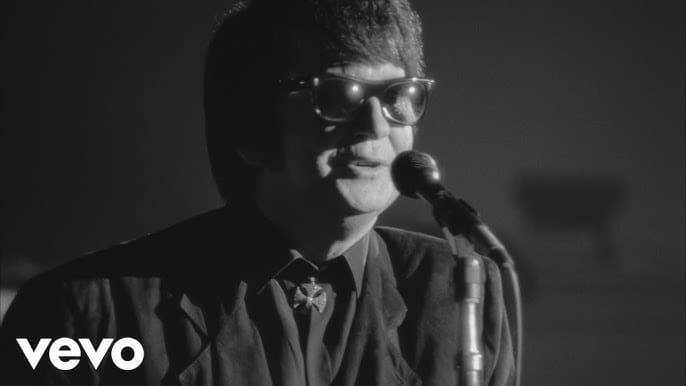
A Rockabilly Spark That Never Lost Its Smile
When Roy Orbison stepped onto the stage for Black & White Night 30 and launched into “Ooby Dooby,” the room did not merely revisit an old rockabilly tune. It reopened the first chapter of a remarkable American music story. Originally released in the late 1950s and later included on Orbison’s debut album At the Rock House, the song became his first genuine breakthrough, climbing into the national charts at a time when rock and roll was still wild, unpredictable, and defiantly young. Long before the operatic heartbreak of “Crying” or the dark grandeur of “In Dreams,” there was this loose, playful record driven by swagger, rhythm, and pure youthful momentum.
The performance captured in Black & White Night 30 carries a special emotional weight because it reveals an often forgotten side of Orbison. History tends to remember him as the man in black standing motionless beneath dim lights, delivering songs filled with loneliness and impossible longing. Yet “Ooby Dooby” reminds listeners that before the tragedy, before the myth, before the dark glasses became iconic, Orbison was a Texas rockabilly kid chasing excitement with a guitar in his hands and laughter hidden inside the rhythm.
The song itself is deceptively simple. Its lyrics are playful, almost reckless in their energy, built around repetition and movement rather than emotional confession. But that simplicity is exactly why it mattered. In the late 1950s, rock and roll was not trying to sound sophisticated. It was trying to sound alive. “Ooby Dooby” moves with the looseness of a roadside dance hall, powered by hiccupping vocals, sharp guitar accents, and the kind of restless tempo that defined early Sun-era rockabilly. Orbison’s voice, even then, already carried unusual character. He had not yet developed the towering emotional crescendos that would later separate him from every other singer of his generation, but listeners could already hear the control, the clarity, and the strange vulnerability hidden beneath the confidence.
What makes the Black & White Night 30 rendition so affecting is the contrast between past and present. Orbison performs the song not as a nostalgic novelty but as living history. Surrounded by musicians who deeply respected his legacy, he revisits the track with the ease of a man reconnecting with his own youth. There is joy in the performance, but also quiet reflection. By the time of this concert, Orbison had survived devastating personal losses, years of industry decline, and an unexpected late-career revival that introduced him to a new generation. Hearing him sing “Ooby Dooby” after everything he endured transforms the song into something larger than its lyrics.
The audience is not simply hearing a rockabilly hit. They are witnessing the sound of an artist remembering where it all began.
That is why the performance continues to resonate decades later. It captures a rare moment when history folds back onto itself. The young dreamer from Texas and the legendary figure in black briefly become the same man again. And in those bright, bouncing chords of “Ooby Dooby,” listeners can still hear the excitement of rock and roll before fame, sorrow, and time changed everything.