
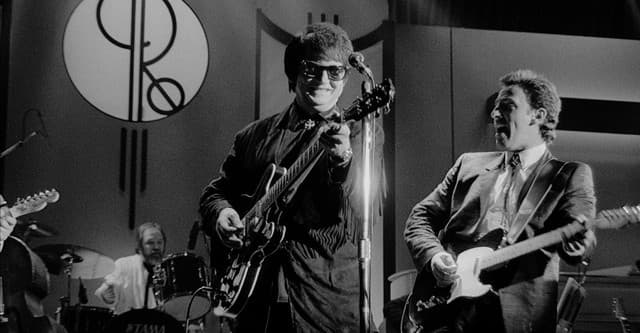
A man long thought lost to time walked back into the light and reminded the world what loneliness truly sounded like.
When Roy Orbison opened “Secret Show Intro (Black & White Night 30)” from the celebrated Black & White Night 30 release, there were no chart statistics demanding attention, no contemporary radio race to measure its success. That was never the point of this performance. The 2017 restoration and expansion of the legendary 1987 concert at Los Angeles’ Cocoanut Grove arrived instead as a historical resurrection — a carefully reconstructed document of one of the most emotionally charged comebacks in American music history. The original televised concert had already become iconic by the late 1980s, but Black & White Night 30 restored the evening in its intended sequence, revealing the atmosphere with greater intimacy and dramatic weight.
The “Secret Show Intro” functions less as a conventional musical track and more as the opening frame of a myth returning to life. Before a single lyric fully settles into the room, the introduction establishes something rare in popular music: reverence. Not manufactured celebrity worship, but genuine artistic admiration. On that stage stood an astonishing assembly of musicians — among them Bruce Springsteen, Elvis Costello, Bonnie Raitt, Tom Waits, and k.d. lang — all gathered not to overshadow Orbison, but to stand beside him like disciples honoring a master craftsman.
That context matters deeply when listening to this introduction. By 1987, Orbison was no longer viewed by the industry as a dominant commercial force. Rock music had hardened, pop had modernized, and many pioneers of the early 1960s had become archival figures rather than living presences. Yet the moment Orbison appears in Black & White Night, dressed entirely in black beneath those unmistakable dark glasses, time seems to collapse inward. The introduction captures that fragile second before memory becomes reality.
There is something profoundly cinematic about the tension in the room. The audience knows they are witnessing more than a concert; they are watching vindication. Orbison had endured personal tragedy throughout his life — the devastating loss of his wife Claudette in a motorcycle accident, followed by the deaths of two of his sons in a house fire years later. Those wounds always lived inside his voice. Unlike many singers who performed heartbreak, Orbison sounded as though heartbreak had permanently altered his anatomy. Even silence around him carried emotional gravity.
That is why the “Secret Show Intro” resonates beyond its brief runtime. It announces the return of a man whose music never relied on youthful rebellion or fashionable coolness. Orbison’s power came from vulnerability elevated into operatic grandeur. He sang loneliness as though it were sacred scripture. The introduction quietly prepares the listener for that emotional descent.
Viewed decades later, “Secret Show Intro (Black & White Night 30)” has become an overture to legacy itself. It frames not merely a performance, but a reckoning between past and present. In those opening moments, the audience is reminded that truly great voices do not age into irrelevance. They wait patiently for history to circle back and recognize them again. And when that recognition finally arrives, as it did for Roy Orbison on that unforgettable black-and-white stage, it feels less like nostalgia than destiny.