
A Man Who Once Sang of Heartbreak Returns to Whisper About Memory, Desire, and the Ghosts We Carry
When Roy Orbison stepped onto the stage for Black & White Night in 1987, he was not merely reviving old hits for a nostalgic audience. He was reclaiming his voice from history itself. Among the most quietly devastating moments connected to that era is “(All I Can Do Is) Dream You”, later revisited in the Black & White Night 30 – Alternate Version, a performance that reveals Orbison not as the untouchable rock pioneer of the early 1960s, but as an aging romantic confronting memory with trembling grace. Originally released in 1989 on the album Mystery Girl, the song became part of Orbison’s extraordinary late-career renaissance following his years of relative commercial silence. Though not among his highest-charting singles, it arrived during a remarkable resurgence that restored him to the cultural center shortly before his death in December 1988.
There is something hauntingly appropriate about the title itself. Orbison spent much of his career singing about impossible longing, but “(All I Can Do Is) Dream You” feels less like youthful yearning and more like surrender to emotional inevitability. The song carries the weight of a man who understands that certain loves no longer belong to reality—they survive only in memory, imagination, and sleepless reflection. Unlike the operatic heartbreak of “Crying” or the dramatic loneliness of “Only the Lonely,” this song moves with remarkable restraint. Orbison no longer pleads with fate; he simply confesses defeat before it.
Musically, the composition drifts with the polished atmosphere characteristic of late-1980s production, yet Orbison’s voice prevents it from ever sounding artificial or dated. His vocal phrasing remains astonishingly human—fragile in one breath, immense in the next. Even in the alternate performance tied to Black & White Night 30, there is an almost cinematic stillness surrounding him. The arrangement leaves room for silence, and Orbison understood silence better than most singers of his generation. He knew how to let a pause ache.
The emotional core of the song rests in its acceptance of distance. The narrator does not promise reunion, revenge, or redemption. He acknowledges absence as permanent. That is what gives the performance its mature emotional gravity. Younger artists often sing about heartbreak as catastrophe; Orbison sang about it as atmosphere—something that settles into the walls of a life and never truly disappears.
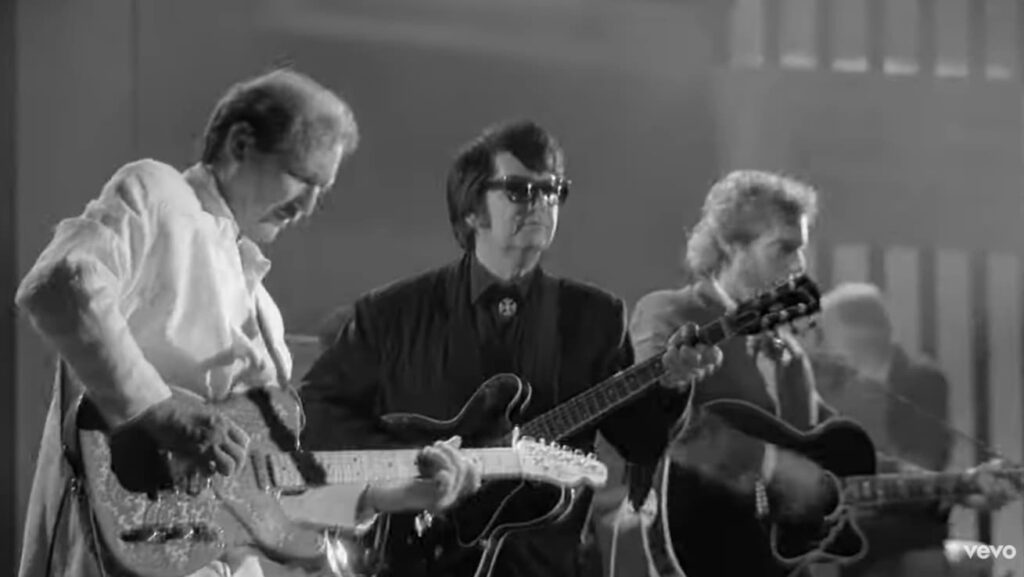
By the late 1980s, Orbison himself had become a figure suspended between eras. His peers viewed him as a legend, younger musicians revered him, and audiences rediscovered the startling emotional purity that had always separated him from other rock-and-roll pioneers. During the Black & White Night sessions, surrounded by admirers such as Bruce Springsteen, Elvis Costello, and Tom Waits, Orbison appeared almost spectral: dressed in black, standing nearly motionless, allowing the voice to carry decades of accumulated sorrow. That context deepens the emotional resonance of “(All I Can Do Is) Dream You.” It sounds like a man singing not only to a lost lover, but to vanished years themselves.
What makes the alternate version especially affecting is the sense of intimacy it preserves. The performance lacks the theatrical urgency of Orbison’s early television appearances. Instead, it possesses the quiet authority of lived experience. Every line feels weathered. Every note sounds earned. The grandeur is still there, but it no longer seeks applause.
In the end, “(All I Can Do Is) Dream You” stands as one of the most revealing late-period recordings in Roy Orbison’s catalog because it captures the artist exactly where his greatest songs always lived: somewhere between loneliness and beauty, memory and surrender. Few singers ever understood that territory better. Fewer still could make it sound this timeless.