
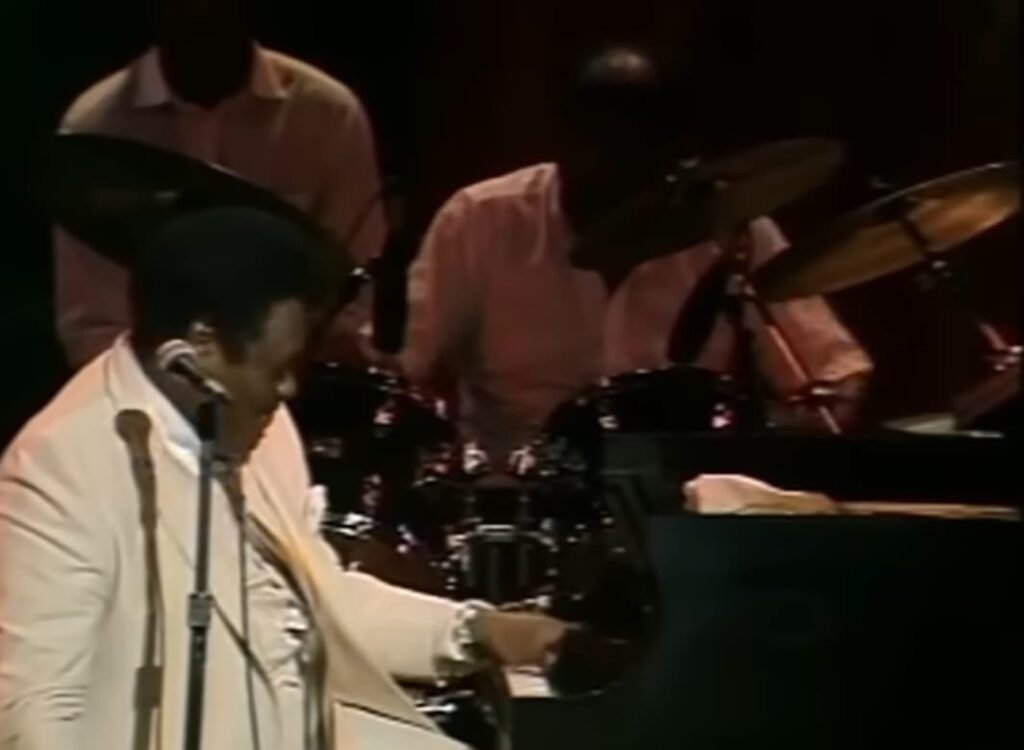
The Voice of New Orleans That Turned Heartache, Homecoming, and Joy Into American Poetry
Few artists in the first golden age of rock and roll carried the emotional weight of everyday life with the effortless grace of Fats Domino. Emerging from the pulse of New Orleans rhythm and blues in the 1950s, Domino became one of the defining architects of early rock music, placing more than three dozen songs on the pop charts and selling millions of records at a time when the barriers between Black rhythm and blues and mainstream American radio were only beginning to crack. Songs like “Ain’t That a Shame”, released in 1955 on the album Rock and Rollin’ with Fats Domino, climbed to No. 1 on the R&B charts and crossed into the pop mainstream with astonishing force. “Walking to New Orleans”, issued in 1960 and later included on Walking to New Orleans, became one of his most emotionally enduring recordings, while “I Want to Walk You Home” reached the pop Top 10 in 1959. Even his interpretation of “Jambalaya (On the Bayou)” revealed how naturally he could absorb Southern musical traditions and reshape them through the rolling piano rhythms of New Orleans.
What separated Fats Domino from many of his contemporaries was never theatrical rebellion. He did not need the dangerous mystique that surrounded early rock and roll. His power came from warmth — from sounding like a man who understood loneliness without bitterness and joy without performance. Listening to these songs decades later feels less like hearing historical recordings and more like opening old family photographs that somehow still breathe.
“Ain’t That a Shame” remains one of the clearest examples of early rock and roll transforming private heartbreak into communal release. Domino’s piano bounces with deceptive lightness while the lyrics carry genuine disappointment. The genius of the record lies in that contradiction. The sadness never collapses into despair because the rhythm insists life keeps moving. That balance between sorrow and swing became one of the defining signatures of New Orleans music itself. In Domino’s hands, heartbreak was not dramatic tragedy; it was human weather.
Then came “Walking to New Orleans”, perhaps the most emotionally cinematic recording of his career. Written by Bobby Charles, the song carries the ache of devotion so absolute that distance becomes meaningless. The narrator would rather walk endlessly than remain separated from the one he loves. Domino delivers the lyric with extraordinary restraint, allowing the orchestra, the slow shuffle rhythm, and his weary vocal phrasing to create the emotional gravity. There is no excess in the performance. Every pause feels intentional, like footsteps on an empty highway at dusk. Few records from the era captured longing with such quiet dignity.
“I Want to Walk You Home” reveals another side of Domino’s artistry — tenderness stripped of ego. In an age when many love songs relied on grand declarations, Domino understood the emotional intimacy hidden in small gestures. Wanting simply to walk someone home becomes an act of care, protection, and affection. His delivery avoids sentimentality because it sounds entirely believable. That authenticity became central to his legacy. Audiences trusted him.
Even “Jambalaya”, rooted in the Cajun classic first popularized by Hank Williams, becomes transformed through Domino’s rhythmic language. The song stops being merely a regional standard and instead turns into a celebration of Louisiana’s cultural bloodstream — Creole rhythms, Southern storytelling, dancehall energy, and neighborhood memory woven together into something joyful and alive.
The enduring beauty of Fats Domino lies in how unforced everything sounded. His piano never demanded attention; it invited people closer. His voice carried no vanity, only humanity. In many ways, these songs document a disappearing America — corner bars glowing after midnight, front porches humming in summer heat, jukeboxes echoing through small rooms where ordinary people tried to hold onto love a little longer. Long after trends faded and louder voices arrived, Domino’s recordings remained because they understood something timeless: the deepest music rarely shouts. It simply tells the truth with enough soul for generations to recognize themselves inside it.