
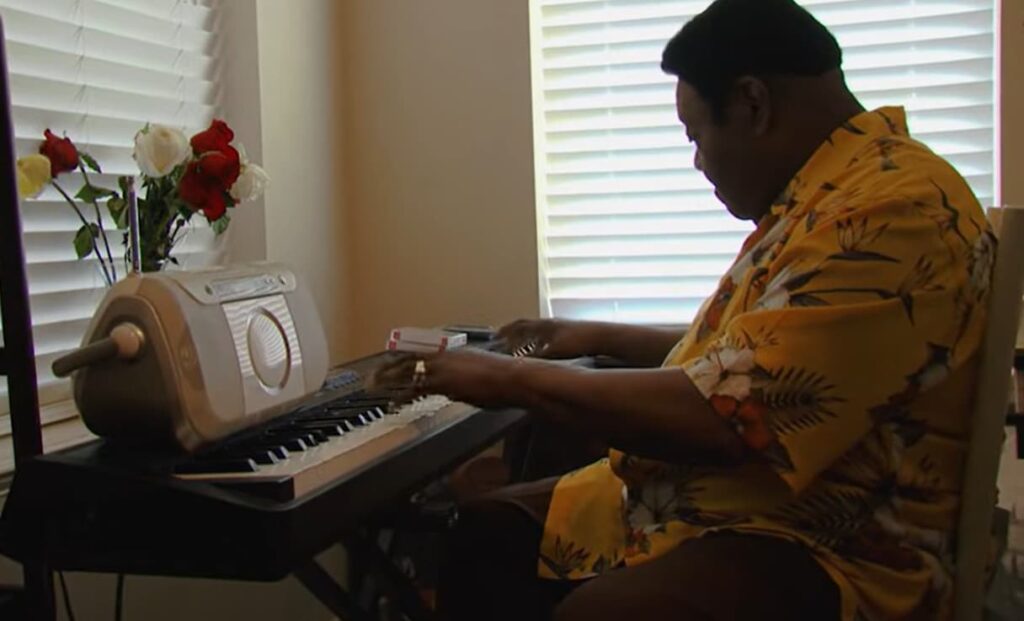
The Piano Becomes a Passport to Joy, Community, and the Heart of New Orleans
In the vast and joyful catalog of Fats Domino, few recordings capture the spirit of his musical identity more directly than “Play Piano At Home.” Though the song was never among the chart-conquering singles that propelled Fats Domino to international fame, it stands as a revealing reflection of the qualities that made him one of the most beloved figures in American popular music. Emerging from the fertile musical landscape of New Orleans, Domino built a career that transformed rhythm and blues into a universal language, scoring a remarkable string of hit records while helping lay the foundation for rock and roll itself. Whether heard alongside classics such as “Blueberry Hill,” “Ain’t That a Shame,” or “I’m Walkin’,” “Play Piano At Home” serves as a reminder that the piano was never merely an instrument in Domino’s world—it was a companion, a storyteller, and a source of communal joy.
To understand the deeper resonance of the song, one must first understand the man behind it. Unlike many of his contemporaries whose performances often projected rebellion or dramatic emotional turmoil, Fats Domino cultivated something warmer and more inviting. His recordings rarely sounded confrontational. Instead, they radiated hospitality. Listening to Domino often feels less like attending a performance and more like being welcomed into a neighborhood gathering where music flows naturally through conversation, laughter, and shared experience. That atmosphere lies at the heart of “Play Piano At Home.”
The song’s title itself carries a deceptively simple message. On the surface, it appears to celebrate the act of making music in one’s own living room, away from grand stages and commercial ambitions. Yet beneath that simplicity is a philosophy that defined Domino’s artistic life. The piano becomes a symbol of accessibility rather than exclusivity. In an era when popular music was increasingly becoming a global industry, Domino never lost touch with the idea that music begins in ordinary places: family homes, neighborhood clubs, church halls, and street-corner gatherings. The invitation to “play piano at home” suggests that music belongs to everyone, not merely to professionals or virtuosos.
Musically, the recording reflects the hallmarks of the New Orleans sound that Domino helped popularize around the world. His piano style, influenced by boogie-woogie, blues, and traditional rhythm and blues, possesses an effortless rolling quality. The left hand provides a steady, almost locomotive pulse, while the right hand dances across the keys with melodic grace. This approach creates an atmosphere of motion and optimism. Even when Domino sang about longing, heartbreak, or uncertainty, the music itself often retained an undercurrent of resilience. In “Play Piano At Home,” that characteristic warmth transforms the song into a celebration of music’s ability to brighten everyday life.
What makes the recording especially compelling is how it reflects the democratic spirit of early rock and roll. Before the genre became associated with stadiums, massive tours, and celebrity culture, it thrived in local communities where ordinary people gathered to sing, dance, and play. Domino’s work consistently preserved that connection to everyday experience. His voice—unpretentious, relaxed, and unmistakably human—never sought to overwhelm listeners with technical bravado. Instead, it conveyed sincerity. The same quality resonates throughout “Play Piano At Home,” where the emphasis remains not on spectacle but on participation.
There is also a subtle nostalgia embedded within the song’s appeal. For many listeners, the image of a piano in the home evokes a vanished era when families gathered around instruments rather than screens, when music was something actively created rather than passively consumed. Domino’s recording taps into that cultural memory without becoming sentimental. Rather than mourning what has been lost, it celebrates what remains possible whenever people choose to make music together. In that sense, the song functions as both a tribute to tradition and an affirmation of music’s enduring relevance.
Viewed within the larger context of Fats Domino’s legacy, “Play Piano At Home” becomes more than a simple novelty or lesser-known album track. It embodies the values that made Domino an enduring figure in American music: warmth, accessibility, rhythmic vitality, and an unwavering belief in the power of song to bring people together. Decades after its release, the recording continues to echo a truth that lies at the heart of Domino’s art—that music’s greatest magic often occurs not in concert halls or recording studios, but in the everyday spaces where ordinary people gather, listen, and find joy in a shared rhythm.