
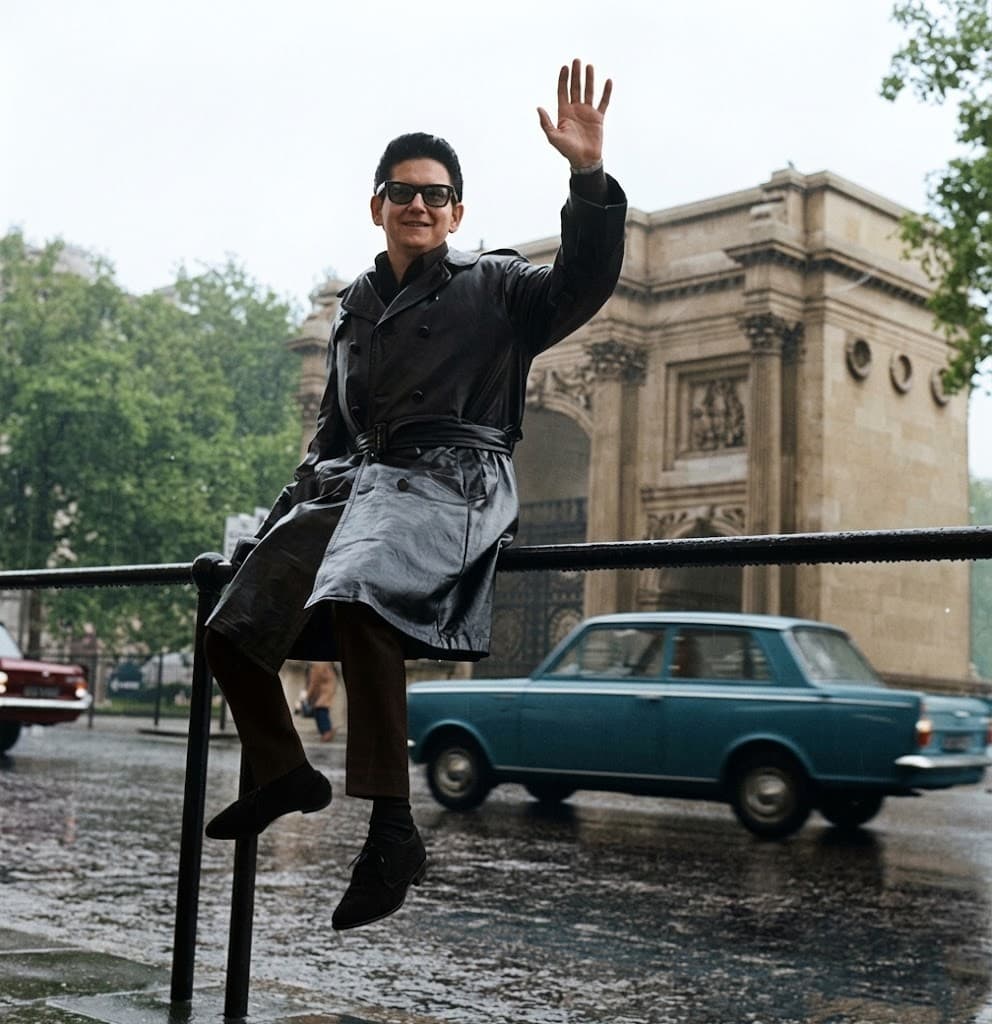
WHEN LONDON STOOD STILL FOR ROY ORBISON
On March 20, 1966, Roy Orbison stepped onto the stage of the legendary London Palladium at a fascinating moment in his career. Unlike a conventional hit single with a chart position to measure its success, the London Palladium performance (1966) stands as a live television event that captured Orbison during one of the most important periods of his international popularity. The broadcast came just months before the release of The Classic Roy Orbison, the 1966 album that produced Twinkle Toes, a Top 30 hit in the United Kingdom and one of the last major chart successes of Orbison’s original 1960s run.
What makes this performance so remarkable is not merely the songs themselves, but the contrast between Orbison and the era surrounding him. By 1966, popular music had become increasingly visual. The British Invasion was in full swing, stages were growing louder, and performers were expected to command attention through movement and charisma. Yet Orbison did the opposite. Dressed in black, hidden behind his famous dark glasses, he stood almost motionless. Reports surrounding the broadcast note that he was recovering from a foot injury sustained in a motorcycle accident, making his already restrained stage presence even more pronounced.
And still, nobody could look away.
The London Palladium set showcased many of the songs that had transformed Orbison into one of the most distinctive voices of the rock-and-roll era: Oh, Pretty Woman, In Dreams, It’s Over, and Twinkle Toes. These songs reveal the extraordinary duality at the heart of his artistry. On one hand, he could deliver chart-friendly pop with effortless accessibility. On the other, he possessed a near-operatic emotional range that few rock singers before or since have matched. His voice did not simply sing melodies—it inhabited them, rising from delicate vulnerability to towering crescendos that felt almost cinematic.
Watching the 1966 Palladium performance today feels like witnessing a disappearing world. This was the final chapter of the early Orbison phenomenon before the personal tragedies that would soon reshape his life and career. Yet there is no hint of that future sorrow in the performance itself. Instead, there is a master craftsman at work, presenting songs built on loneliness, longing, heartbreak, and hope with a level of conviction that remains startling decades later.
Perhaps that is why the footage continues to resonate. It captures something increasingly rare in popular music: absolute confidence in the power of a voice. No elaborate choreography. No visual spectacle. No attempt to compete with the trends of the day. Only Roy Orbison, standing beneath the lights of the London Palladium, proving that emotional truth can command a room more completely than any theatrical performance.
More than a concert, the 1966 London Palladium appearance serves as a living document of Orbison’s singular gift. It preserves the moment when one of popular music’s most haunting voices stood perfectly still—and somehow made the entire world listen.