
A Simple Love Remembered Becomes an Eternal American Dream
When Fats Domino transformed Blueberry Hill into one of the defining recordings of the rock-and-roll era in 1956, he did far more than revive an old standard. Originally written in 1940, the song found a completely new life through Domino’s warm New Orleans rhythm, becoming the biggest pop hit of his career. The recording climbed to No. 2 on the Billboard pop chart and spent eight weeks at No. 1 on the R&B chart, later appearing on This Is Fats Domino!, the landmark album that helped cement his place among the architects of early rock and roll.
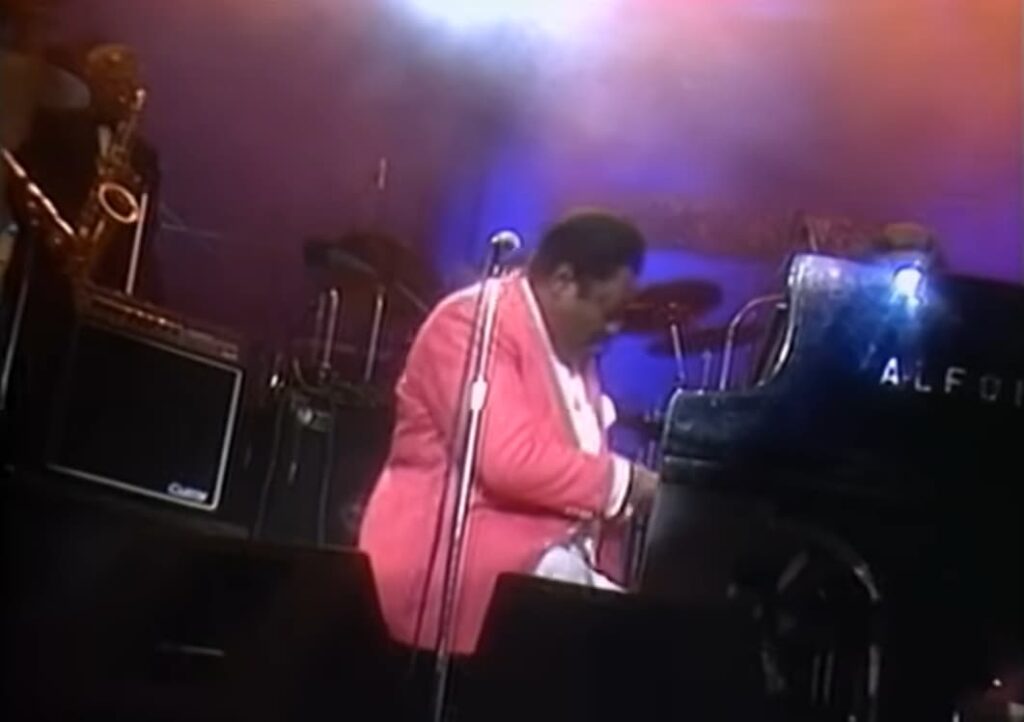
The live performances of Blueberry Hill reveal something especially profound about Domino as an artist. In the studio version, the song already radiates warmth and tenderness, but on stage it becomes almost conversational—as though an old friend is sitting at a piano, recalling a memory that has never quite faded. Domino never approached the song with theatrical heartbreak or dramatic anguish. Instead, he sang it with the gentle certainty of a man looking back on a moment that changed his life forever.
At its heart, Blueberry Hill is a song about memory. The famous opening line, “I found my thrill on Blueberry Hill,” sounds deceptively simple, yet it captures one of the most universal human experiences: the tendency to preserve our happiest moments long after they have disappeared. The hill itself functions less as a physical place than as a symbol—a landscape of nostalgia where love remains untouched by time.
What makes Domino’s interpretation extraordinary is the contrast between the lyrics and the music. The song tells of a romance that has vanished, but the performance never sinks into despair. His rolling piano lines, rooted in rhythm and blues, create an atmosphere of comfort rather than sorrow. There is sadness here, certainly, but it is the sadness of acceptance. The narrator does not rage against loss; he treasures what once existed.
This emotional balance became one of the recording’s greatest strengths. During the 1950s, many popular songs explored heartbreak, yet Fats Domino approached the subject with remarkable restraint. His relaxed vocal phrasing suggests that love’s value is not diminished by its ending. Some memories become precious precisely because they cannot be repeated.
The cultural legacy of Blueberry Hill is equally significant. The song helped bridge traditional American pop, rhythm and blues, and the emerging language of rock and roll. Domino’s version introduced millions of listeners to a style that was deeply rooted in New Orleans musical traditions while remaining universally accessible. Decades later, it continues to stand as one of the most beloved recordings of the twentieth century, a testament to the power of simplicity in popular music.
Listening to Blueberry Hill (Live) today feels less like hearing a performance and more like opening a cherished photograph album. Every note carries the glow of remembrance. Every lyric reminds us that the places where we once found joy never truly disappear. They survive in memory, waiting for a familiar melody to bring them back to life.