
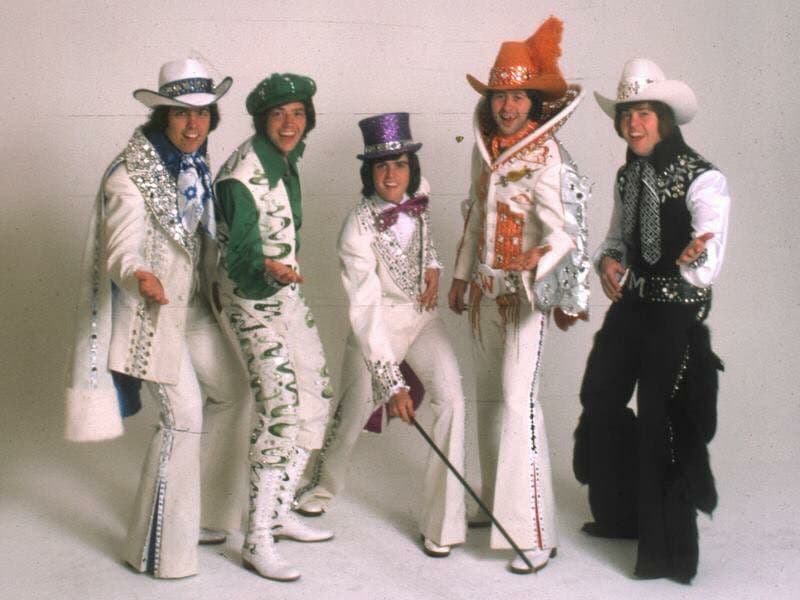
“Crazy Horses” is the thunderous warning that progress without conscience can become humanity’s greatest stampede toward destruction.
Released in 1972, “Crazy Horses” became one of the most surprising and ambitious recordings in The Osmonds’ career. Featured on the album Crazy Horses, the single reached No. 2 on the UK Singles Chart and became a major international success, while also earning respectable chart positions across Europe and North America. For a group widely associated with polished pop harmonies and family-friendly entertainment, The Osmonds shattered expectations by embracing a far heavier rock sound—distorted guitars, pounding rhythms, and a relentless vocal intensity that stood in stark contrast to their earlier hits. More than a stylistic reinvention, “Crazy Horses” announced that the band was willing to confront contemporary issues with a sense of urgency rarely expected from mainstream pop idols of the era.
What makes “Crazy Horses” remarkable is the way its title disguises its true subject. At first glance, listeners might imagine an untamed western tale or a metaphor for youthful rebellion. Instead, the “crazy horses” are machines—automobiles pouring smoke into the atmosphere, symbols of industrial excess and humanity’s growing dependence on technology. Long before environmental awareness became a dominant cultural conversation, The Osmonds transformed concerns about pollution into a piece of hard-driving rock that sounded every bit as restless as the world it criticized. The relentless rhythm mirrors the roar of engines, while the thick layers of guitar and keyboards evoke a landscape consumed by mechanical noise. It is a rare example of a socially conscious message delivered not through quiet reflection, but through sheer sonic force.
Equally compelling is the song’s refusal to preach. Rather than presenting solutions, “Crazy Horses” captures the unsettling realization that society itself has become trapped inside the momentum it created. The lyrics convey a world racing forward with little regard for the consequences, where innovation and convenience threaten to outpace wisdom. That tension gives the song a timeless quality. Every generation discovers its own “crazy horses”—whether they take the form of pollution, unchecked consumption, or technologies advancing faster than our ability to govern them responsibly. In this sense, the song transcends its early-1970s origins, speaking as powerfully to the twenty-first century as it did to audiences hearing it for the first time.
Musically, the recording remains one of the boldest statements in The Osmonds’ catalogue. Alan Osmond’s gritty lead vocal carries an urgency that borders on desperation, while the aggressive instrumentation challenged critics who had dismissed the family band as lightweight entertainers. The fusion of hard rock, glam influences, and infectious melodic instincts produced a record that was both commercially accessible and artistically adventurous. Its driving riff, explosive chorus, and unapologetic energy continue to surprise listeners who know the group only through their earlier bubblegum-pop successes.
More than fifty years after its release, “Crazy Horses” endures as one of rock’s most unexpected environmental anthems. It stands as evidence that meaningful social commentary can emerge from the least expected voices, and that a band willing to reinvent itself can leave behind far more than chart success. In the enduring crackle of vinyl, “Crazy Horses” still gallops with unstoppable force—not merely as a relic of its time, but as a reminder that the loudest warnings in popular music are often the ones that continue echoing long after the amplifiers fall silent.