
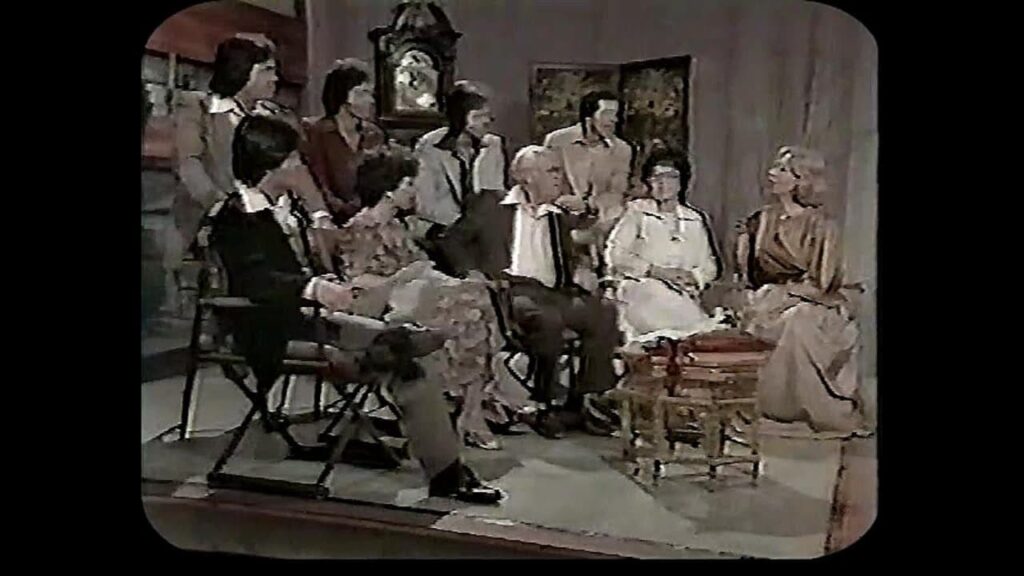
A Family That Once Filled Stadiums Returned Home to Utah and Revealed the Quiet Heart Behind the Fame
By 1978, The Osmonds were no longer simply a pop phenomenon frozen in the hysteria of early-1970s teen culture. The screaming crowds, gold records, and chart dominance that had carried songs like “One Bad Apple” and “Love Me for a Reason” into international success had begun to evolve into something more reflective, more personal. That transition became remarkably visible in “Dinah Visits The Osmond Family in Utah”, the television special hosted by Dinah Shore, taped at the family’s newly built Osmond Studios in Orem, Utah, and broadcast in November 1978.
Unlike the polished machinery of network variety television that had defined much of the decade, this special carried a different emotional temperature. It was not built around chart positions or the frantic need to sustain teen-idol momentum. Instead, it offered audiences something unusually intimate for the era: a portrait of a family attempting to preserve its identity while standing inside the fading afterglow of superstardom.
The setting itself mattered deeply. By the late 1970s, the Osmonds had invested heavily in building their own production studio in Utah rather than remaining fully embedded within Hollywood’s entertainment ecosystem. That decision revealed a great deal about who they were beneath the commercial image. While many acts of the period drifted toward excess, reinvention, or collapse under the pressure of fame, the Osmonds leaned inward — toward family, faith, and creative control. “Dinah Visits The Osmond Family in Utah” captures that philosophy almost accidentally. The cameras are interested not only in performance, but in domestic rhythm: parents, siblings, conversation, history, and the strange balancing act between celebrity and ordinary life.
What makes the special enduring is its subtle tension. By 1978, popular music was changing rapidly. Disco dominated radio. Punk had already challenged the innocence of early-decade pop. The clean-cut optimism that once made the Osmonds feel untouchable suddenly belonged to another cultural chapter. Yet rather than resisting that reality, the special almost embraces it with grace. There is no desperation in its tone. No attempt to appear rebellious or aggressively modern. Instead, there is warmth — the kind that now feels almost archival in American entertainment history.
The performances throughout the program carry that emotional undercurrent. Even when the music remains upbeat, there is a sense that the family understands its place within a changing world. Viewers are not simply watching entertainers; they are witnessing survivors of a cultural moment that had already begun slipping into memory. That awareness gives the special its unusual poignancy today.
For longtime admirers of the Osmonds, the program also serves as a reminder that their appeal was never solely rooted in commercial success. Beneath the merchandising empire, the television fame, and the polished harmonies was a disciplined musical family shaped by relentless touring, spiritual conviction, and a genuine belief in togetherness. In hindsight, “Dinah Visits The Osmond Family in Utah” feels less like a celebrity showcase and more like a time capsule from the final years of classic American variety television — a moment when entertainment still believed sincerity could stand onstage without irony.
And perhaps that is why the special continues to resonate. It preserves something the modern industry rarely allows artists to reveal anymore: not reinvention, not scandal, not mythology — but simple humanity.