
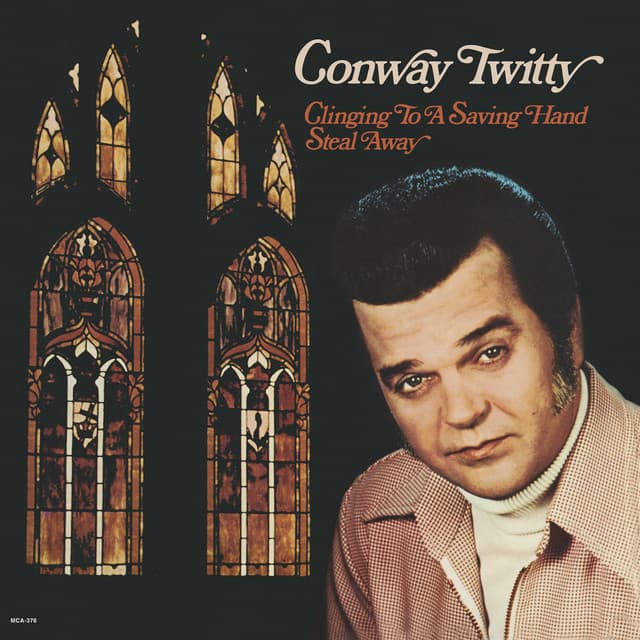
Gospel confession where faith is not declared loudly, but held tightly against the weight of living.
Upon its release in 1971, Clinging To A Saving Hand carried Conway Twitty into rare territory, a sacred recording that nonetheless found its way onto the Billboard Hot Country Singles chart, reaffirming his singular ability to blur the boundary between personal belief and public performance. The song appeared on the album Come Along With Me, a project that placed reverence beside romantic vulnerability and treated gospel not as a departure, but as a continuation of Twitty’s lifelong conversation with devotion, doubt, and human frailty.
Originally written by Rose Lee Maphis, Clinging To A Saving Hand is built on imagery older than the recording industry itself. It speaks in the language of hymns, but its power lies in restraint rather than proclamation. Twitty does not approach the song as a preacher or a revivalist. He sings as a man who has already lived through temptation, loss, and regret, and now understands that faith is often less about triumph than survival. The saving hand is not dramatic or distant. It is close, worn, and familiar, something reached for quietly in moments when pride has finally been exhausted.
Musically, the arrangement is intentionally unadorned. Gentle piano lines and measured accompaniment give Twitty’s voice the space to settle into its natural gravity. His baritone does not soar. It steadies. Each phrase is delivered with the patience of someone who has learned that conviction grows slowly, through repetition and experience. This is gospel as lived practice rather than spectacle. The song moves forward at the pace of walking, not running, reinforcing its central idea that endurance, not urgency, is the true act of faith.
Lyrically, the song avoids abstraction. The imagery of storms, valleys, and guiding hands is direct and universally understood, but Twitty’s interpretation adds a layer of autobiography without ever naming it. By 1971, his career had already included reinvention, controversy, and an awareness of how easily public admiration can coexist with private instability. In that context, Clinging To A Saving Hand reads less as testimony and more as acknowledgment. Faith here is not presented as a reward for righteousness, but as a necessity for those who know their own weaknesses too well.
The cultural resonance of the song lies in its quiet confidence. At a time when country music was increasingly theatrical, Twitty chose humility. The recording suggests that belief does not require certainty, only persistence. That message allowed the song to reach listeners beyond the church pew, speaking to anyone who has needed something steady when momentum failed.
In the broader arc of Conway Twitty’s catalog, Clinging To A Saving Hand stands as a moment of stillness. It does not compete for attention. It waits. Decades later, that patience remains its strength, offering reassurance not through volume or authority, but through the simple act of holding on.