
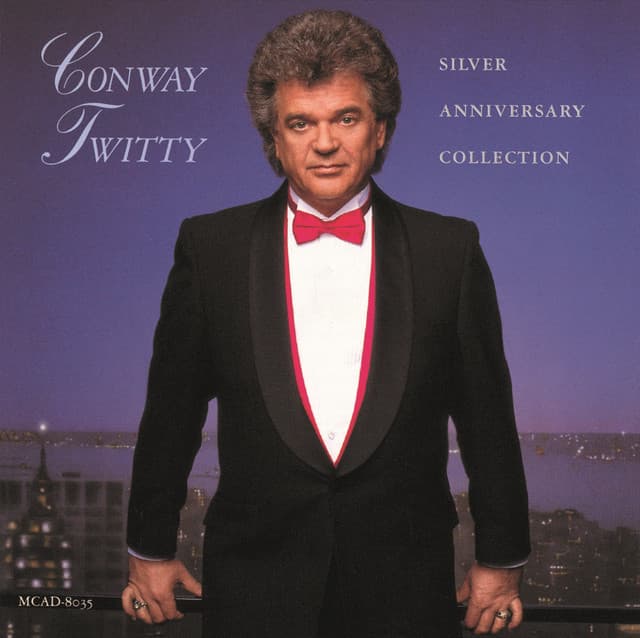
A quiet confession of human weakness, where desire outruns the fragile boundaries of the heart
Released during the remarkable late-career resurgence of Conway Twitty, “Guess My Eyes Were Bigger Than My Heart” appeared on his 1983 album Lost in the Feeling, a period when Twitty had already secured his place among country music’s most commanding voices. The song became one of the defining singles from that record, climbing to No. 6 on the Billboard Hot Country Singles chart and reminding listeners that Twitty’s greatest strength was never simply his voice, but the emotional realism he carried into every line he sang.
To understand the quiet power of “Guess My Eyes Were Bigger Than My Heart”, one must appreciate the artistic territory Conway Twitty had mastered by the early 1980s. Long past the youthful rockabilly beginnings that first introduced him to audiences in the late 1950s, Twitty had evolved into something far rarer in country music: a storyteller of intimate moral conflicts. His songs often unfolded not in grand gestures but in moments of personal reckoning. A man standing alone with the truth of his own mistakes. A love discovered too late. A promise broken by impulse rather than cruelty.
This song belongs squarely in that tradition. The title itself carries the kind of homespun wisdom that country music has long cherished. The phrase suggests a simple human failing: seeing something one wants, reaching for it, and only afterward realizing the heart was never built to carry the consequences. In the narrative voice of the song, the confession is not dramatic. It is weary, almost reflective. The singer recognizes that temptation, fleeting and bright, has led him beyond the boundaries of loyalty and emotional honesty.
What gives “Guess My Eyes Were Bigger Than My Heart” its lasting resonance is the way Twitty delivers that realization. His voice, deep and unmistakably textured, carries both authority and vulnerability. By this stage of his career, every subtle inflection in his phrasing had the weight of experience behind it. He does not rush the lyric. Each line unfolds with the deliberate pacing of a man piecing together the truth of his own actions.
Musically, the arrangement reflects the polished country sound of the early 1980s. Smooth guitar lines, restrained rhythm, and warm background harmonies create an atmosphere that allows Twitty’s vocal to remain at the emotional center. Yet beneath that smooth surface lies a tension that mirrors the song’s theme. The melody moves gently forward, but the lyrics circle around regret, acknowledging that certain mistakes cannot simply be undone.
Within the broader arc of Conway Twitty’s catalog, “Guess My Eyes Were Bigger Than My Heart” stands as another example of his ability to transform everyday human weakness into something quietly profound. His songs rarely judged their characters harshly. Instead, they offered something closer to understanding. The people inside these stories are flawed, tempted, and often regretful, but they are never beyond empathy.
Listening today, the song feels like a small but revealing window into the emotional landscape Twitty explored throughout his career. Fame, love, loyalty, temptation. These are the recurring elements of the human drama he sang about for decades. In “Guess My Eyes Were Bigger Than My Heart,” the drama is stripped to its simplest form: a man realizing that wanting something and being able to live with it are not the same thing.
And in that quiet realization lies the enduring truth of the song.