
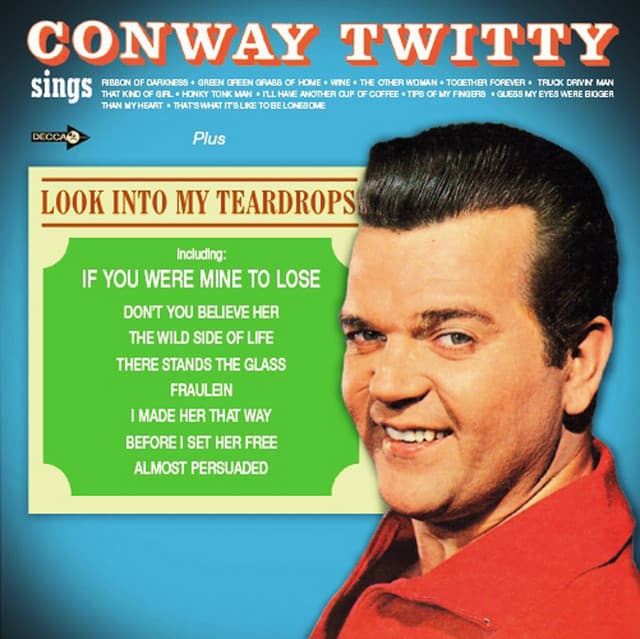
Look Into My Teardrops distills love’s shattered promise into a single, aching plea.
When Conway Twitty released “Look Into My Teardrops” in 1966 as the title track of his album Look Into My Teardrops, it became a quiet but resonant presence on the country charts, peaking at number 36 on the US Country chart and signaling his continued evolution within the genre. Though it did not reach the upper echelons of his later hits, the song remains a testament to Twitty’s ability to capture vulnerability with spare elegance.
Emerging from an era of transition for Twitty, the mid-1960s found him fully embracing country music after earlier success in rock and roll. The album Look Into My Teardrops was released on Decca Records in 1966 and typified the Nashville sound of the period, with slick production, sympathetic arrangements, and Twitty’s warm baritone leading the charge. Against a backdrop of covers and originals alike, “Look Into My Teardrops” stood out as both a heartfelt lament and a showcase for Twitty’s interpretive depth.
At its core, the song is a study in reflected self-examination. Lyrically it invites a lover—or perhaps the listener—to peer into the singer’s tears and there to see the image of a love that has been broken and betrayed. The repeated refrains ask us to view those tears not merely as drops of sorrow but as mirrors of the soul, each one encapsulating the memory of promise and hurt. In this sense, the song transcends the specific narrative of romantic loss to become an elegy for vulnerability itself: a reminder that pain, when witnessed, unites listener and performer in shared empathy.
The musical structure reinforces this emotional aim. Written in the key of G and moving at a moderate tempo, the arrangement frames Twitty’s voice with minimalistic accompaniment that underscores his lyrical lament without overwhelming it. The simple chord progression and gentle phrasing give the listener space to dwell on the words, to feel the weight of each dropped tear, and to reflect on their own experiences of love and loss. It is a song that refuses to hurry its sorrow; instead, it invites stillness.
In the broader arc of Twitty’s career, “Look Into My Teardrops” may not be the most celebrated title in his catalogue, yet it exemplifies his capacity to infuse country balladry with introspection. Long before his string of number one hits in the 1970s and 1980s, this song reveals an artist deeply attuned to the textures of emotional truth. It is a quietly compelling reminder that behind the glossier hits lies a body of work shaped by simplicity and sincerity, where the pain of a heartbreak is not just sung but lived.