
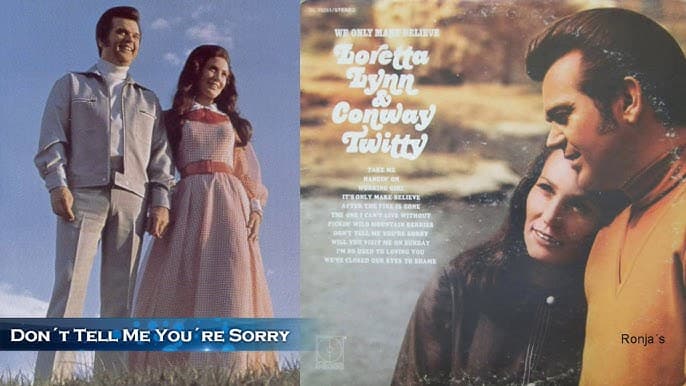
Stern refusal of hollow remorse, where love demands truth instead of ritual regret
Released as a single in 1974, Don’t Tell Me You’re Sorry by Conway Twitty & Loretta Lynn rose to the top of the Billboard Hot Country Singles chart and became one of the defining moments of their legendary duet partnership. The song appeared on the album Country Partners, a record that captured the pair at the height of their commercial power and emotional clarity. By this point, Twitty and Lynn were no longer an experiment in chemistry. They were a force, trusted by audiences to tell uncomfortable truths with grace, bite, and unmistakable authenticity.
At its core, Don’t Tell Me You’re Sorry is not about reconciliation. It is about exhaustion. The lyric does something rare in country music of its era. It rejects apology as a substitute for accountability. Rather than dramatizing heartbreak through grand gestures, the song narrows its focus to a single, devastating realization. Words have been repeated too often to mean anything anymore. Sorry has lost its weight.
The brilliance of the song lies in its conversational structure. The verses unfold like a private argument overheard through a thin wall. There is no narrator standing above the story. Instead, there are two voices locked in emotional standoff. Loretta Lynn delivers her lines with restrained steel, embodying a woman who has already made peace with disappointment. Her voice does not crack. It does not plead. That calm is the most cutting element of all. Conway Twitty, by contrast, sings with wounded insistence, his phrasing carrying the ache of a man who realizes too late that sincerity cannot undo repetition.
Musically, the arrangement stays deliberately grounded. A steady country shuffle, unobtrusive steel guitar, and measured tempo leave space for the lyric to breathe. Nothing distracts from the emotional exchange. This restraint reflects a deeper truth about the song’s impact. It does not overwhelm the listener. It corners them. By the final chorus, the listener understands that the relationship has already shifted into a colder, more permanent shape.
Culturally, the song stands as a mature counterpoint to the romantic idealism that often defined male female duets. Rather than flirting or sparring playfully, Twitty and Lynn portray a relationship shaped by history, imbalance, and fatigue. This realism resonated deeply with adult audiences who recognized themselves in the silence between the lines. It is no accident that the song found its way to number one. It spoke to listeners who had outgrown dramatic promises and learned the cost of repeated forgiveness.
In the long arc of their collaboration, Don’t Tell Me You’re Sorry endures as one of their most emotionally disciplined recordings. It does not beg for sympathy. It offers recognition. Decades later, its power remains undiminished, because the truth it carries is timeless. An apology without change is not healing. It is noise.