
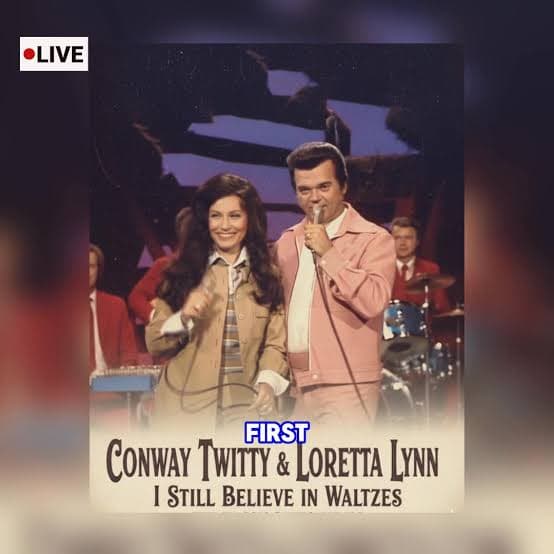
A fragile dance of faith and doubt where love endures, even as the music begins to fade
When Conway Twitty and Loretta Lynn reunited for I Still Believe In Waltzes, the song arrived as part of their collaborative album I Still Believe in Waltzes, a release that reaffirmed their enduring chemistry as one of country music’s most compelling duos. The title track itself found notable success on the country charts, continuing a legacy of duets that consistently resonated with audiences. Yet beyond its chart performance, the live renditions of I Still Believe In Waltzes reveal something more intimate. They capture two seasoned voices not merely performing a song, but inhabiting a shared emotional space shaped by years of storytelling together.
At its core, the song is built upon a simple but deeply evocative metaphor. The waltz, with its measured three-step rhythm, becomes a symbol of balance, tradition, and emotional harmony. To still believe in waltzes is to hold onto the idea that relationships can move with grace, even when the world around them shifts toward something less certain. In the hands of Conway Twitty and Loretta Lynn, this metaphor gains remarkable depth. Their voices do not merely complement one another. They converse, question, and ultimately reconcile within the structure of the song.
The live performance setting adds an essential layer to this dynamic. There is a visible and audible interplay between the two artists, a subtle negotiation of phrasing and tone that mirrors the lyrical tension. Twitty’s voice carries a grounded warmth, often suggesting reassurance, while Lynn’s delivery introduces a delicate vulnerability, hinting at doubt and emotional wear. Together, they create a dialogue that feels authentic rather than scripted, as though the song is unfolding in real time.
Musically, the arrangement honors the traditional elegance of the waltz form. The rhythm is steady, almost hypnotic, providing a foundation upon which the emotional narrative can unfold. Unlike more elaborate productions, the instrumentation here remains understated, allowing the vocal interplay to take precedence. This restraint is crucial. It ensures that the listener’s attention remains fixed on the subtle shifts in emotion that define the performance.
Lyrically, I Still Believe In Waltzes explores the tension between nostalgia and reality. It acknowledges that relationships evolve, that the effortless harmony suggested by the waltz is not always sustainable. Yet it also resists cynicism. The belief in waltzes becomes an act of quiet defiance, a refusal to abandon the ideals that once defined love. This duality is where the song finds its lasting power. It does not offer resolution, but it does offer persistence.
Within the broader arc of their careers, this performance stands as a mature reflection of what Conway Twitty and Loretta Lynn represented together. They were not simply partners in song, but interpreters of the complexities within human connection. Their duets often navigated themes of love, conflict, and reconciliation, and I Still Believe In Waltzes distills those themes into a single, poignant statement.
What remains after the final note is not just the melody, but the lingering sense of something delicately sustained. A relationship that may no longer move as effortlessly as it once did, yet continues to find its rhythm nonetheless. In that quiet persistence, Conway Twitty and Loretta Lynn remind us that belief, even when tested, can still carry its own kind of grace.