
A Man Looks at the Woman Beside Him and Realizes Love Survived His Own Restlessness
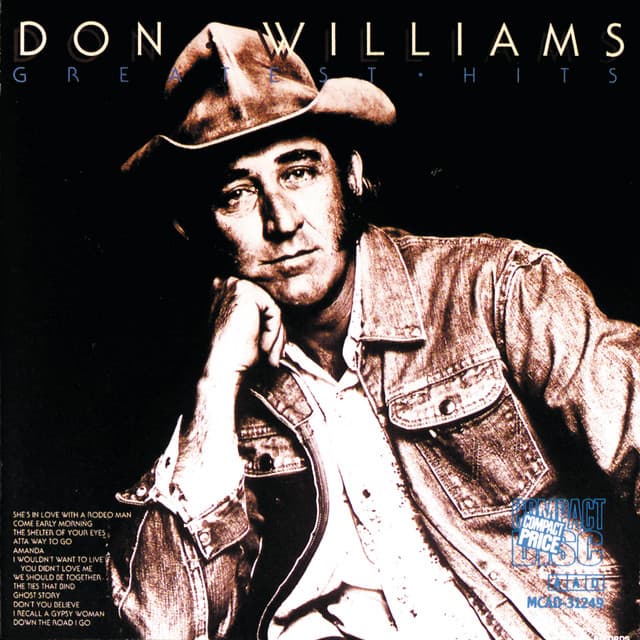
When Don Williams recorded Amanda in 1973, later carried into wider circulation through the success of his early 1970s catalog and often associated with the quiet rise of his 1974 era, he was still becoming the figure country music would soon know as “The Gentle Giant.” The song appeared as the B side to the Top 20 country hit Come Early Morning, taken from Don Williams Volume One, and Amanda itself eventually reached No. 33 on the Billboard Hot Country Singles chart. Yet numbers only tell part of the story. What endured was not commercial force, but emotional permanence.
Written by Bob McDill, one of the great poets of modern country songwriting, Amanda carries the kind of honesty that seems almost dangerous in its simplicity. There is no dramatic betrayal, no grand declaration, no orchestral climax trying to force emotion into the listener’s chest. Instead, the song unfolds like a private confession spoken late at night after years of hard miles and quiet regret.
The narrator is a man confronting age, disappointment, and the unsettling realization that the woman beside him deserved a gentler life than the one he gave her. “Fate should have made you a gentleman’s wife” remains one of the most devastating lines in country music because it arrives without self pity. It is not manipulation. It is recognition.
That was where Don Williams possessed a rare power.
Many singers in the 1970s approached vulnerability by amplifying pain. Williams did the opposite. His voice barely pushes above conversation throughout Amanda. He sings with restraint, almost as if he is afraid to disturb the truth sitting in the room. The result feels startlingly intimate. Listening to him is less like hearing a performance and more like overhearing a man finally admitting something he has carried for years.
Musically, the arrangement reflects the same emotional discipline. Soft acoustic textures, understated rhythm, and spacious production leave room for reflection. Nothing rushes. Nothing competes with the lyric. The silence between phrases becomes part of the storytelling itself. That patience would later become central to the entire Don Williams identity, separating him from the louder and more theatrical side of country music during the decade.
The song also captured a particular strain of working class masculinity rarely expressed with such tenderness. The narrator is not glamorous. He is worn down by roads, bars, guitars, and time. He understands his limitations too late. Yet the song never collapses into despair because love still exists inside the regret. That tension gives Amanda its extraordinary emotional depth. It is both apology and gratitude at once.
Years later, Waylon Jennings would transform Amanda into a major No. 1 country hit, introducing the song to an even broader audience. But the original recording by Don Williams remains haunting in a different way. Jennings brought outlaw grandeur to the lyric. Williams brought quiet humanity.
And perhaps that is why the song still lingers decades later.
Not because it tells listeners how to feel, but because it recognizes something many people eventually discover for themselves: sometimes love is measured not by perfection, but by the painful awareness that someone stayed beside you despite all the reasons they could have walked away.