
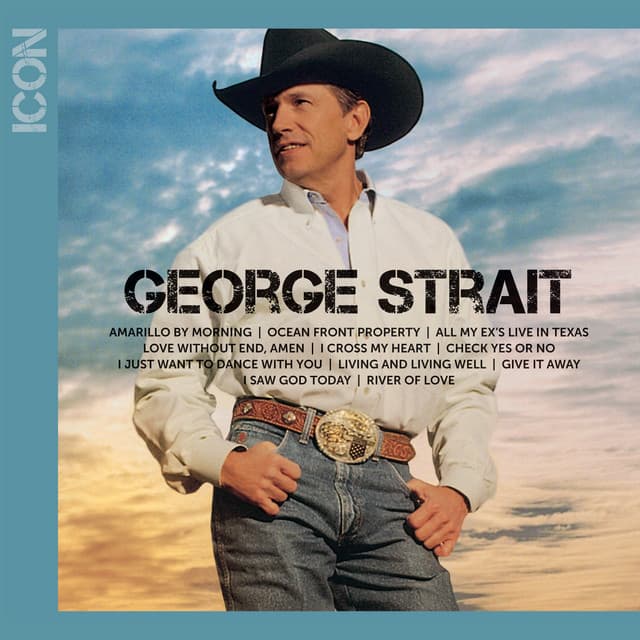
A lone cowboy’s quiet dignity endures where dreams fade but identity remains unbroken
Few songs in country music carry the quiet authority of Amarillo by Morning, a defining recording by George Strait, released on his 1982 album Strait from the Heart. Though it reached only No. 4 on the Billboard Hot Country Songs chart upon its release, its cultural resonance has long surpassed its initial chart performance, evolving into one of the most enduring and revered pieces in Strait’s vast catalog.
Originally written by Terry Stafford and Paul Fraser, Amarillo by Morning found its ultimate voice in George Strait, whose interpretation distilled the song to its emotional essence. By the early 1980s, Strait was emerging as a torchbearer for a more traditional country sound, pushing back against the increasingly polished Nashville production trends of the era. This recording became a cornerstone of that identity, not through grand gestures, but through restraint, authenticity, and an unwavering commitment to storytelling.
At its core, Amarillo by Morning is a song about survival stripped of illusion. The narrator is a rodeo rider, a figure deeply embedded in the mythology of the American West. Yet this is no romanticized cowboy anthem. Instead, it is a meditation on endurance in the face of physical hardship and emotional depletion. Broken bones, lost money, and fading prospects are recounted with a matter-of-fact tone that feels almost stoic. The line between pride and resignation blurs, creating a portrait of a man who has lost much, yet refuses to relinquish the essence of who he is.
What elevates the song beyond mere narrative is the way George Strait delivers it. His voice is measured, unembellished, and profoundly human. There is no theatrical strain, no overt attempt to dramatize the pain within the lyrics. Instead, Strait allows the weight of the story to settle naturally, trusting the listener to feel the gravity without being instructed. This interpretive choice aligns perfectly with the song’s thematic core. The cowboy does not complain. He persists.
Musically, the arrangement reinforces this emotional landscape. The fiddle weaves through the track like a distant memory, while the steel guitar adds a sense of open space, evoking long highways and empty horizons. There is a deliberate simplicity at work, each instrument serving the narrative rather than competing with it. The production leaves room for silence, for breath, for the kind of reflection that defines great country music.
Over time, Amarillo by Morning has transcended its origins to become something closer to a cultural touchstone. It is frequently cited as one of George Strait’s signature songs, not because of commercial dominance, but because of its emotional truth. The song speaks to a broader human experience, the quiet perseverance required to continue moving forward when circumstances offer little reward.
In the end, Amarillo by Morning is not about reaching a destination. It is about the journey itself, and the identity forged along the way. The rodeo rider may arrive with nothing left but his name, yet in that name lies everything that cannot be taken from him.