
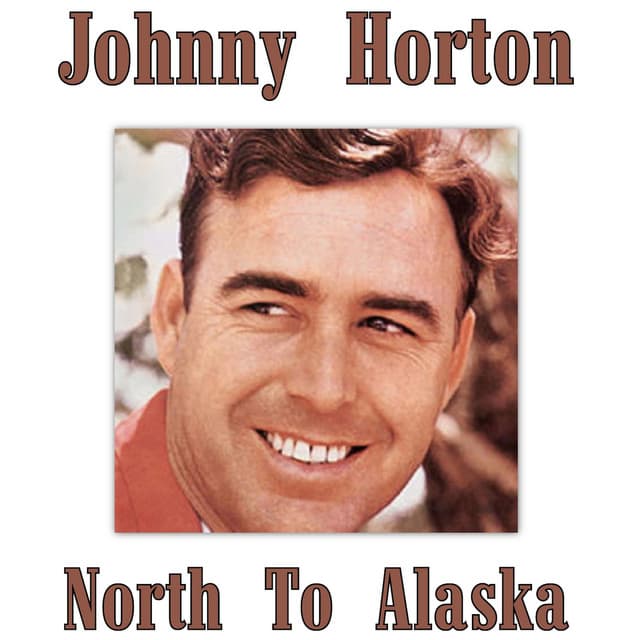
A rousing frontier anthem that turns the Gold Rush into a swaggering celebration of ambition, luck, and American myth.
Released in 1960, Johnny Horton’s North to Alaska roared onto the charts with the same confidence it celebrates in its lyrics, climbing to number one on the Billboard Hot 100 and simultaneously topping the country charts. The song served as the title track and thematic anchor of the album North to Alaska, and it was written for the Hollywood film of the same name, positioning Horton at the crossroads of popular music, cinema, and American folklore at the dawn of a new decade.
At its surface, North to Alaska is a novelty narrative, a brisk and boisterous tale of fortune seekers racing toward the frozen promise of gold. Yet beneath its infectious chorus and marching rhythm lies a distilled version of the American frontier myth, retold for the postwar era. Horton was already known as a master of historical storytelling, a singer who could compress sweeping events into three minute epics, and here he trades battlefield tragedy for comic bravado and restless optimism. The song’s characters are not heroes in the classical sense. They are hustlers, dreamers, and opportunists, driven less by destiny than by the simple belief that somewhere beyond the horizon, riches are waiting for those bold enough to claim them.
Musically, the track is engineered for momentum. The galloping rhythm evokes sled dogs and riverboats as much as it does the forward push of Manifest Destiny. Horton’s vocal delivery is playful yet authoritative, his phrasing crisp and buoyant, as if he is both narrator and participant in the mad dash northward. The production is lean and bright, allowing the story to remain front and center, a hallmark of Horton’s finest recordings. Nothing lingers too long, mirroring the impatience of men who cannot afford to stand still.
What makes North to Alaska endure is not historical precision, but emotional truth. The Gold Rush setting becomes a metaphor for any moment when hope outweighs reason, when the promise of transformation justifies the risk of failure. Released at the cusp of the 1960s, the song resonated with an audience poised between tradition and change, still enamored with frontier legends even as the nation looked toward space, technology, and modernity. Horton’s Alaska is less a place than a state of mind, a belief that reinvention is always possible if one is willing to head north, metaphorically or otherwise.
In the broader arc of Johnny Horton’s career, North to Alaska stands as a lighter counterpart to his more somber historical ballads, yet it is no less revealing. It captures his rare ability to balance scholarship and showmanship, history and entertainment. More than six decades later, the song remains a vivid artifact of American pop culture, reminding listeners that some stories persist not because they are true, but because they express something timeless about who we think we are, and who we hope to become.