
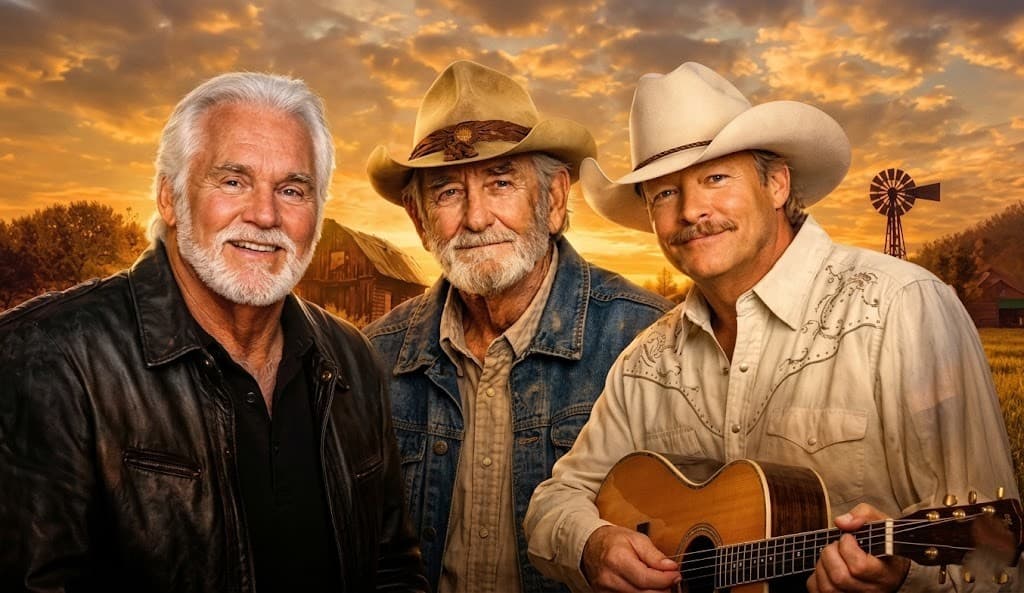
Three Voices, One Highway of Memory Where Country Music Refused to Fade Away
By the time Kenny Rogers, Don Williams, and Alan Jackson became synonymous with the emotional backbone of American country music, each man had already carved out a distinctly different path through the genre’s evolving landscape. The collection Classic Country Music Greatest Hits 2026 stands less as a conventional album and more as a living archive of country music’s most enduring virtues: restraint, heartbreak, dignity, and quiet storytelling. Though released in the streaming era under a compilation format rather than as a traditional studio collaboration, the project gathers together songs that once dominated radio charts, crossed generational boundaries, and transformed ordinary human experiences into permanent musical memory.
For listeners raised on the golden decades of country music, the emotional gravity of this collection is immediate. Kenny Rogers, whose crossover success helped country music enter the mainstream consciousness of the late 1970s and 1980s, brought cinematic storytelling into songs like “The Gambler” and “Lucille.” His voice carried the weathered wisdom of a man who had seen too much life to waste words unnecessarily. Meanwhile, Don Williams, often called “The Gentle Giant,” approached country music from the opposite direction — softer, steadier, almost conversational. Songs such as “I Believe in You” and “Tulsa Time” did not demand attention; they earned it through sincerity. Then there was Alan Jackson, the bridge between classic honky-tonk tradition and modern Nashville polish, whose work in the 1990s restored a sense of rural realism at a time when country music was drifting toward commercial spectacle.
What makes a compilation like Classic Country Music Greatest Hits 2026 resonate so deeply is not nostalgia alone. Nostalgia is easy. What these recordings offer instead is emotional permanence. Country music, at its finest, has always understood that pain rarely arrives dramatically. It appears quietly — in kitchen silences, empty highways, unanswered calls, and memories that linger long after people disappear. These artists mastered that language.
The collection also reveals how differently masculinity was once expressed in country music. Modern popular music often rewards excess — louder emotion, sharper confession, grand declarations. But Don Williams could communicate loneliness with almost whispered restraint. Kenny Rogers turned moral dilemmas into folklore. Alan Jackson preserved the voice of working-class America without reducing it to caricature. Together, their songs became portraits of men carrying grief privately, loving imperfectly, and enduring life without spectacle.
Musically, the compilation functions as a timeline of country music’s evolution across nearly four decades. The lush orchestration surrounding Kenny Rogers reflects the countrypolitan era’s attempt to widen Nashville’s audience. Don Williams remained rooted in stripped-down acoustic warmth, allowing melody and lyrical honesty to lead. Alan Jackson, meanwhile, revived fiddle-driven traditionalism while maintaining contemporary accessibility. Hearing these styles side by side reveals not division, but continuity — proof that country music’s emotional core survived every commercial reinvention.
There is also something haunting about hearing these voices together in 2026, particularly in an age increasingly dominated by disposable digital trends. Many of these songs were created long before algorithms dictated taste. They were built patiently, often by songwriters who understood that a lasting song does not chase relevance; it waits for human experience to catch up with it.
That may be the true power behind Classic Country Music Greatest Hits 2026. It reminds listeners that country music was never merely about trucks, bars, or heartbreak clichés. At its highest form, it became literature for ordinary people — songs carrying the emotional history of families, small towns, lost lovers, aging fathers, and lonely travelers driving home beneath fading radio signals. And in the voices of Kenny Rogers, Don Williams, and Alan Jackson, those stories still sound painfully alive.